

Boa Vista - The Turtle Island, in detail.
Boa Vista is the island of endless, empty beaches, the iconic Cabo Santa Maria shipwreck, and arguably the most impressive wildlife spectacle in Cape Verde: between June and October, around two-thirds of all Cape Verde's loggerhead sea turtle nesting sites are found here - at night, the animals come ashore to lay their eggs. Here's what you actually need for planning, with no marketing fluff.
Boa Vista in 60 seconds.
Boa Vista is the island of endless, empty beaches and Cape Verde's most important sea turtle nesting sites. If you want calm and want to escape Sal's denser tourism, you'll find more untouched nature here - with reliable wind for kitesurfers and a similarly high level of safety.
Boa Vista at a glance.
- Location
- Barlavento group, south of Sal, north of Maio
- Area
- ~620 km² - Cape Verde's third-largest island
- Main towns
- Sal Rei (administration & tourism) · Rabil (near the airport)
- Airport
- Aristides Pereira Int'l (BVC), ~5 km from Sal Rei
- Population
- ⚠ Can vary by source
~12,789 (2021 census, INE Cabo Verde) - other census-based sources cite figures between roughly 12,613 and 12,798; treat this as an approximate figure - Highest point
- Monte Estância, 387 m - natural monument, ~23 km southeast of Sal Rei
- Language
- Portuguese (official) · Kriolu (everyday) · English common in hotels & tourist areas
- Currency
- Cape Verdean escudo (CVE), fixed peg to the euro: €1 = 110.265 CVE
- Time zone
- UTC-1 (no daylight saving time in Cape Verde)
- Power
- 220-230 V, plug type C/F - travelers from continental Europe usually need no adapter; UK, US, and most other visitors will need one
- Tap water
- Treated via seawater desalination - many travelers still prefer bottled water
- Tourist tax
- 276 CVE (~€2.50) per person per night, age 16+, capped at 10 nights
Who is Boa Vista right for?
Boa Vista is Cape Verde's second most-visited island - but noticeably quieter and less developed than Sal. An honest look before you book.
A good fit for...
- Nature lovers who want to experience sea turtle watching (Jun-Oct) - unique to this island
- Anyone looking for miles of empty beach rather than busy promenades
- Kitesurfers and windsurfers (Nov-May)
- All-inclusive travelers - several large resorts cluster around Sal Rei and Praia de Chaves
- Photographers and anyone seeking peace and quiet
Less of a fit for...
- Anyone wanting lively nightlife or infrastructure beyond the resorts - Boa Vista is noticeably quieter than Sal
- Hikers and culture seekers - Santo Antão, Fogo or Santiago offer much more there
- Spontaneous travelers without advance planning - direct flights from Europe are less frequent and more day-of-week-dependent than on Sal
- Anyone expecting exclusively green, lush landscapes - Boa Vista, too, is mostly arid
When is the best time to visit?
Like Sal, Boa Vista has an arid, consistent climate with a steady northeast trade wind - almost no rain, warm all year round.
The annual average is around 26°C. Rainfall is concentrated almost entirely between August and October, peaking in September (around 43 mm) - the rest of the year stays essentially rain-free. The northeast trade wind blows reliably from November to May (roughly 16-22 knots) and becomes considerably less steady from June to September. November through June is considered the best time to visit.
Weather phenomenon: Bruma Seca
Between December and February, a high-pressure system over the Sahara can carry desert dust across the entire Cape Verde archipelago ("Bruma Seca") - visibility noticeably hazes over, and in pronounced cases drops significantly according to Cape Verde's meteorological service. This can be unpleasant for people with respiratory issues; a light mask for sensitive days doesn't hurt.
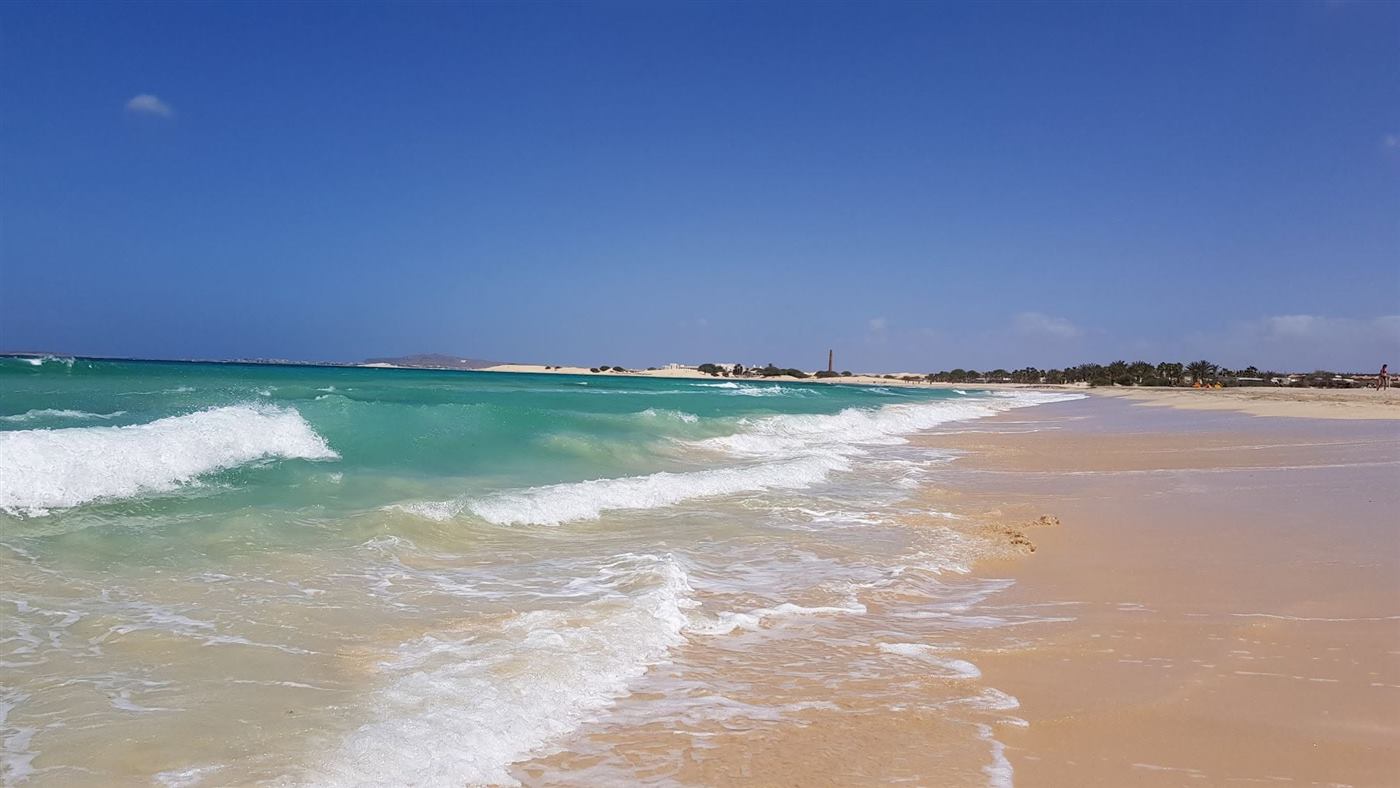
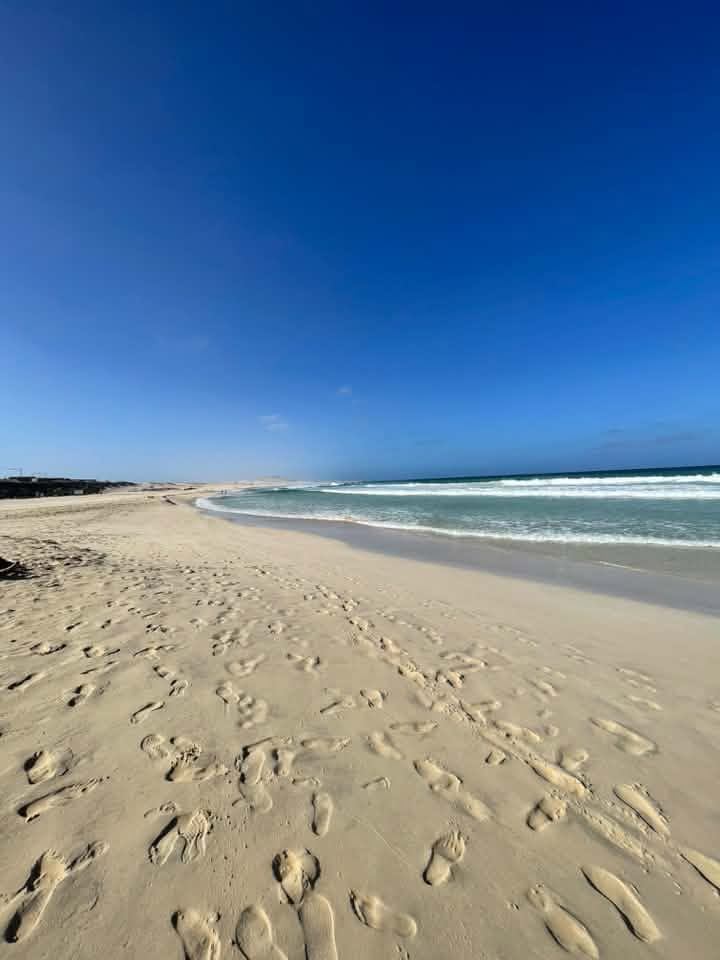
Miles of beach, barely a soul in sight - Boa Vista in its rawest form.
The beaches of Boa Vista.
Six defining beaches - from Cape Verde's most famous wilderness to a quiet family beach near Rabil.
Praia de Santa Mónica
The island's flagship beach: 16 to 18 kilometers of almost untouched coastline in the south, near Povoação Velha. No lifeguards, barely any infrastructure - but pure, open space in return. Currents and waves can be strong, especially in wind - not for weak swimmers.
Praia de Chaves
Around 5 kilometers of broad, golden sand on the west coast near Rabil - home to several large all-inclusive resorts. Spacious and rarely crowded, though wind and wave conditions right on the beach can vary.
Praia de Atalanta
On the island's north coast - and home to the beached cargo ship Cabo Santa Maria, one of the most photographed sights in Cape Verde (details below under Sights).
Praia das Gatas
On the northeast coast near Ilhéu dos Pássaros - named after the nurse sharks ("gatas") often seen in the sheltered bays offshore in summer. A popular diving and snorkeling spot with coral and rock formations.
Praia de Varandinha
On the southwest coast, within the Parque Natural do Norte: limestone cliffs and sea caves shaped by erosion, walkable depending on the tide. Also a nesting site for loggerhead sea turtles (Jun-Oct) and a popular surf spot - better for photography and nature than for swimming.
Praia de Cabral
About 2 km of golden sand right next to Sal Rei - the easiest-to-reach beach on foot, with sun loungers, beach bars and restrooms. Sea turtles also lay their eggs here between June and October.
A note on currents
Praia de Santa Mónica is known for its sometimes powerful current and waves - confirmed by multiple independent sources, and there's no lifeguard on site. Praia de Chaves, Praia das Gatas and Praia de Cabral are considered somewhat more sheltered, but are also unsupervised. If you want to play it safe - especially with kids - stick to a resort's supervised pool area.
Praia de Santa Mónica - one of the longest, most untouched coastlines in Cape Verde, with almost no infrastructure.
More than just the beach.
Cabo Santa Maria (shipwreck)
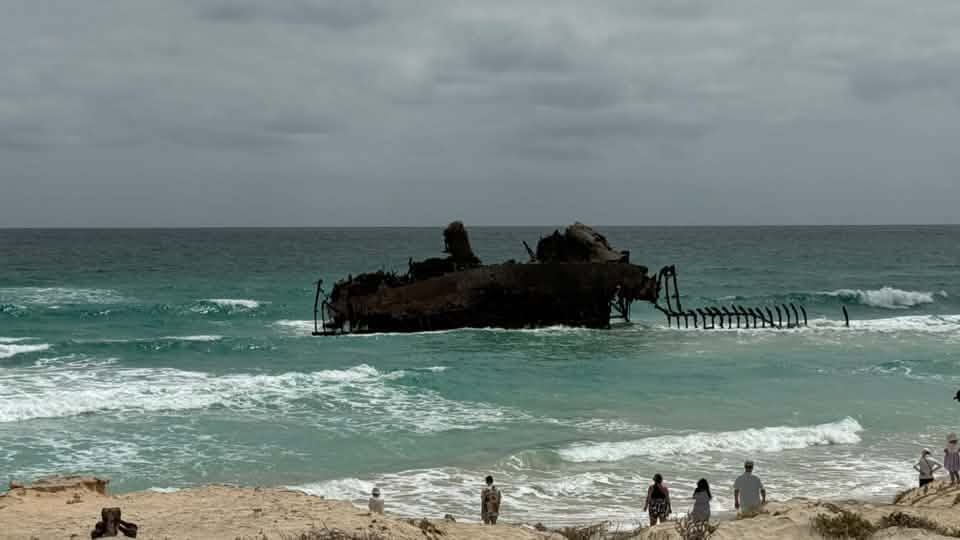
Built in Cartagena in 1957, the 130-meter Spanish cargo ship MS Cabo Santa Maria ran aground off Boa Vista on September 1, 1968, en route from Genoa to Buenos Aires - carrying, among other things, bells for the new cathedral in Brasília. The 28-member crew was unharmed, and part of the cargo was salvaged at the time with help from the local population. The wreck has sat at Praia de Atalanta ever since, today a wind- and salt-eaten metal skeleton and one of the most photographed sights in Cape Verde.
Deserto de Viana
A roughly 5 km long, 1 km wide dune field in the island's northwest, with dunes up to 15 meters high - often described as one of Cape Verde's natural wonders. Check locally for exact extent and access/driving rules, since sources vary on the details.
Ilhéu de Sal Rei & Forte Duque de Bragança
An offshore island about 1 km southwest of Sal Rei, reachable by boat. It holds the ruins of Forte Duque de Bragança, built between 1818 and 1820, which once protected the harbor and salt warehouses from pirate raids.
Curral Velho
The island's oldest settlement: founded in the 17th century as a fishing and salt-trading village, abandoned in the 19th century after sustained drought and repeated pirate raids - today just ruins amid the dunes in the south, reachable by quad or buggy tour. The surrounding wetland has been its own protected Ramsar site (986 ha) since 2005: a breeding ground for the Cape Verde-endemic Cape Verde shearwater and Cape Verde storm-petrel, as well as another sea turtle nesting stretch.
Photogenic spots
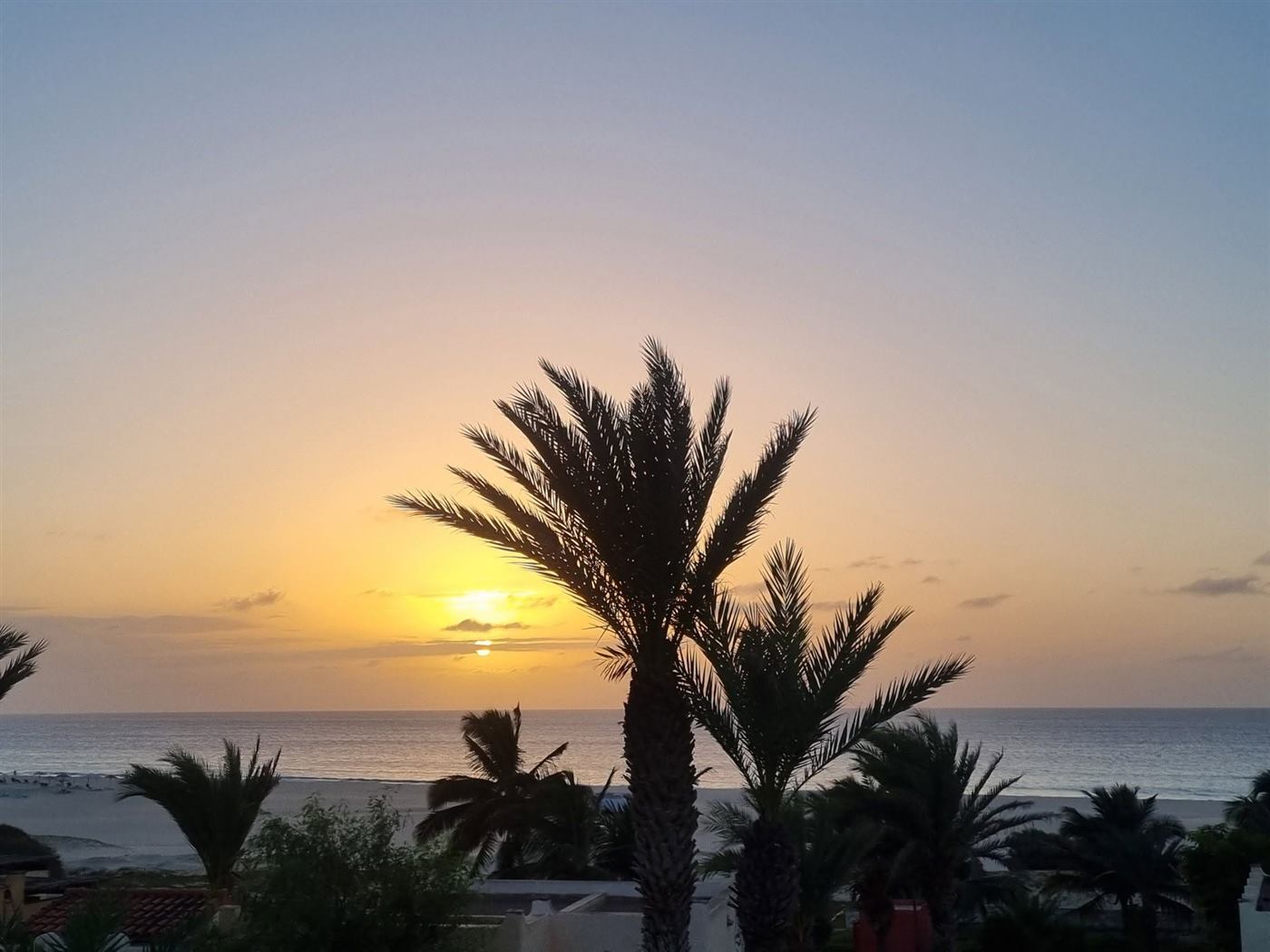
The Cabo Santa Maria wreck is most striking at sunset, when the fading light shines through the rusted metal. The dunes of the Deserto de Viana look best in the low, raking light of early morning or late afternoon. Praia de Santa Mónica delivers the most spectacular wide-angle shots of the endless coastline at low tide.
Boa Vista is also a conservation story.
14 of Cape Verde's 47 protected areas are on Boa Vista - around 37% of the island's land area is protected, the highest share of any Cape Verde island. For visitors, that means great nature, but also clear rules.
Parque Natural do Norte
At around 24,712 hectares, the island's largest protected area - protecting turtle nesting sites as well as habitat for raptors and steppe birds. The Varandinha caves lie within its coastal section.
Reserva Natural Morro de Areia
Around 21 km² on the southwest coast between Praia de Chaves and Praia de Santa Mónica, plus a 300 m-wide marine buffer zone. Protects dune dynamics along with tropicbirds, ospreys and nurse sharks - also home to the Boa Vista gecko (Tarentola boavistensis), a species endemic to the island and listed as "vulnerable" by the IUCN.
Reserva Natural Boa Esperança
Protected by decree since 2014, covering both the Lagoa do Rabil (a Ramsar wetland) and Praia de Atalanta with the Cabo Santa Maria wreck - around 4,010 hectares.
Ilhéu de Baluarte
An uninhabited islet, strictly protected since 1990, about 2 km off the northeast coast - at just under 0.08 km² it's tiny, but notable: it's the easternmost point of the entire Cape Verde archipelago.
Stay on marked tracks
Quad and buggy tours are popular, but are only permitted on designated tracks - driving freely over dunes or through protected areas endangers nesting sites and sensitive ecosystems and can be penalized. For booked tours, choose licensed, locally knowledgeable operators.
Four towns, four faces.
Boa Vista is more than its beaches - Sal Rei, Rabil, Povoação Velha and the north show very different sides of the island.
Sal Rei
The island's main town and tourist base, on the northwest coast. The name means "King of Salt," a nod to its role in 17th-century Atlantic salt trading. After repeated pirate raids, the settlement was relocated in the early 19th century to its current, more defensible site.
Just offshore lies the Ilhéu de Sal Rei with the ruined Forte Duque de Bragança (see Sights).
Rabil
Boa Vista's original 17th-century capital, which lost its significance once sea trade concentrated around Sal Rei. Today known for traditional pottery workshops and its proximity to the airport and to the Lagoa do Rabil, a coastal wetland protected since 2005 as a Ramsar site of international importance.
Povoação Velha
One of the island's oldest settlements, the main town until 1810, today a small, unhurried place with the Nossa Senhora da Conceição chapel - near Praia de Santa Mónica, and a good contrast to the resorts on the west coast.
For an even deeper dive into history: the ghost village of Curral Velho in the south can be visited on a quad or buggy tour (see Sights above).
Fundo das Figueiras, João Galego & Cabeça dos Tarafes
A trio of villages in the island's agricultural north - noticeably quieter and more traditional than the coast. Their shared patron saint is São João Baptista: every June, the three villages hold festival days with card tournaments, processions and traditional food (including cachupa), peaking on June 23 and winding down on June 25.
What there is to do on Boa Vista.
Sea turtle watching
Boa Vista holds around two-thirds of all Cape Verde loggerhead sea turtle nesting sites. Cape Verde as a whole is thought to hold an estimated 9-15% of the species' global population - the third-largest nesting population worldwide after Oman and southeast Florida, and the largest in the entire eastern Atlantic. A long-term study published in ScienceDirect in 2026 (1998-2024, including work by the Turtle Foundation) documents an impressive 80-fold increase in nesting activity at three Boa Vista beaches over 27 years - with up to 22,000 nests per kilometer at the densest beaches in 2021, far more than the roughly 600 nests per kilometer seen in Florida or Oman. By pure nesting density, Boa Vista is therefore likely the world leader, even though the total population officially ranks third. Remarkably, according to the Turtle Foundation, the number of illegally caught turtles on Boa Vista fell from 1,253 in 2007 to just 20 in 2024 - many former poachers now patrol the beaches themselves to protect the nests. Between June and October (at night, usually from around 8pm), licensed guides take small groups to the nesting sites.
Humpback whale watching
Between March and May (peaking mid-March to mid-May), humpback whales pass the coast to calve and mate. Research identifies the Baía de Sal Rei on the west coast as the single most important bay for wintering, calving and nursing humpback whales in the entire eastern Atlantic - making Boa Vista one of Cape Verde's best islands for whale watching. Boat tours typically run around three hours, often with a guide or marine biologist on board.
Kitesurfing & windsurfing
A reliable northeast trade wind (Nov-May, roughly 16-22 knots) makes Boa Vista a serious wind spot - including at Curral Velho. Several schools offer courses for beginners and advanced riders.
Diving & snorkeling
Named dive spots like Praia das Gatas (coral, rock formations, nurse sharks in summer), plus the Cabo Santa Maria wreck as an informal artificial reef. Several dive centers in Sal Rei.
Shark Bay near Santa Mónica
Boa Vista, like Sal, has its own "Shark Bay" - in shallow water near Praia de Santa Mónica, lemon sharks can be spotted, often as part of larger boat tours. Sightings are less reliable than at Sal's Baía da Parda - some visitors see a single animal, others several at once.
Boat trip to the Ilhéu de Sal Rei
A short crossing to the offshore island with the ruined Forte Duque de Bragança, often combined with snorkeling and a fish lunch on board.
Quad & buggy tours
Through the dune landscape of the island's interior to the abandoned village of Curral Velho - a fishing and salt-trading settlement abandoned in the 19th century.
Deep-sea fishing
Half and full-day boat tours out of Sal Rei into the bay, possible year-round.
Birdwatching
The wetlands and offshore islets in the south and east - above all Curral Velho and Ilhéu de Baluarte - are recognized as important seabird breeding grounds, with several Cape Verde-endemic shearwater and storm-petrel species. Most rewarding in the early morning and evening.
Insider tip: licensed turtle tours only
◐ Community valueNesting sites may only be visited with licensed guides - groups are capped at 8 people, only red light is allowed (no flash, no flashlight), and guides position themselves behind the animal, never in front. This isn't a marketing gimmick, it's active species protection: white light and flash can seriously disturb the animals while nesting. The conservation organization Turtle Foundation, together with its Cape Verdean partner organization Fundação Tartaruga, is active on the ground here - not to be confused with Project Biodiversity, which operates on Sal. The Turtle Foundation itself doesn't run tours, as it's fully occupied with conservation work during nesting season - tours are booked through local operators. For context: consuming turtle meat and eggs has been illegal in Cape Verde since 2018.
Community tip: whales sometimes visible from the beach
◐ Community valueSeveral members of our Facebook community report that in calm seas, humpback whales can already be seen from the beach - or even from the breakfast table of some hotels on the Baía de Sal Rei - no boat required. If you still book a boat tour, ask specifically for operators who always have a marine biologist on board: that serves not just infotainment, but also respectful distance from the animals. A few sightings have even been reported as early as February, somewhat ahead of the official season start in March.
That's how much nesting loggerhead turtle activity increased at three Boa Vista beaches between 1998 and 2024 - the result of a 27-year long-term study and decades of local conservation work, including by the Turtle Foundation and Fundação Tartaruga.
How much time should you give Boa Vista?
Three sample rhythms as a guide - not a rigid plan, but a template to adapt.
Short trip / stopover
- Day 1: Arrival, settle in at Sal Rei, sunset on the beach
- Day 2: Cabo Santa Maria & Praia de Atalanta as a half-day tour
- Day 3: Boat trip to the Ilhéu de Sal Rei or a relaxed beach day, departure
Classic beach holiday
- Day 1-2: Arrive, explore Sal Rei & Praia de Chaves
- Day 3: Cabo Santa Maria (Praia de Atalanta) & Deserto de Viana
- Day 4: Boat trip to the Ilhéu de Sal Rei, snorkeling
- Day 5: Praia de Santa Mónica & Povoação Velha
- Day 6: Quad/buggy tour to the ghost village of Curral Velho, or diving at Praia das Gatas
- Day 7: If traveling Jun-Oct: an evening turtle tour; otherwise a rest day at the beach, departure
Combined with island hopping
- Week 1: as above - take your time with all of Boa Vista's beaches, sights and activities
- Week 2: domestic flight to Sal or Santiago for a second island with a different character - especially worthwhile if more infrastructure, nightlife or culture also interest you (see "Who is Boa Vista right for?" above)
Arrival & getting around.
What actually matters after landing - entry requirements, cash, SIM cards and getting around the island.
Entry & airport tax (BVC)
Citizens of the EU, the UK, the US and Canada can enter visa-free for stays of up to 30 days; most other nationalities get a visa on arrival (Australia, for example, falls into this category) - check current requirements for your passport before you travel. Regardless of visa status, online pre-registration via the official EASE portal is mandatory before departure, including the airport security tax (TSA) of currently 3,400 CVE (roughly €31) - paying online at ease.gov.cv is usually cheaper and faster than paying at a counter on arrival.
Aluguer (shared minibuses)
As on the other islands, the cheapest way to get between Sal Rei, Rabil and the beaches - informal shared minibuses with no fixed schedule that leave once full. Pay the driver in cash, in escudos.
Money & ATMs
Cards on the Maestro/Cirrus network work reliably at ATMs; European V-Pay debit cards don't work everywhere, and not every international card network is accepted at every machine - carry a Visa or Mastercard credit card as a backup, plus some cash. ATMs also have daily withdrawal limits.
Getting a local SIM
Carriers Alou and Unitel T+ operate nationwide and have shops in Sal Rei as well - availability right at Boa Vista airport isn't guaranteed in advance, so consider an eSIM as a backup just in case.
Car rental & driving license
Cape Verde drives on the right, as in continental Europe and the US. Several national authorities explicitly recommend carrying an International Driving Permit alongside your national license - for example, Germany's Foreign Office does, while other sources (including rental companies) don't treat it as mandatory. Check your own country's current guidance, and when in doubt, bring both documents.
Tipping & etiquette
Unlike in many countries, there's no fixed tipping culture. Voluntary rounding-up or roughly 5-10% for good service in restaurants is common, though not expected - some places already add a service charge to the bill.
Water is not a given on Boa Vista
Like Sal, Boa Vista has virtually no natural fresh water - over 85% of drinking water on both islands comes from energy-intensive seawater desalination. Growing tourism noticeably increases the strain on this system. Mindful water use on the ground - short showers, reusing towels - genuinely makes a difference.
What you should watch for.
General safety
Like Sal, Boa Vista is frequently rated by travel advisories as one of the comparatively safer Cape Verde islands. Normal precautions are enough: don't leave valuables unattended on the beach, don't go to remote beaches alone, agree on taxi fares beforehand. Check your government's current travel advisory before departure, since assessments can change.
Health & vaccinations
The usual travel vaccinations (including tetanus/diphtheria, hepatitis A) are recommended - seek medical advice before you travel. Cape Verde has been officially malaria-free since 2024. In 2023/2024 there was a nationwide dengue outbreak (around 19,000 cases, 8 deaths, declared over in January 2025) - initially concentrated in Fogo, but shifting markedly toward the capital Praia on Santiago as the year went on - treat this as a general Cape Verde-wide travel-advisory note, not an elevated Boa Vista-specific risk.
Medical care
Basic care is available at the health center in Sal Rei. For more serious cases, patients are often evacuated to Praia or directly to Europe - which is exactly why travel health insurance with real medical evacuation coverage isn't an optional extra for a Cape Verde trip, it's the core of the coverage. This matters especially for divers: a continuously available decompression chamber on the island is not guaranteed, and an evacuation may be necessary in an emergency.
Emergency numbers
Police 132 · Fire department 131 · Ambulance 130. Several international travel sources report these are reachable even without a SIM card (an official confirmation that they're toll-free could not be found) - best saved to your phone right on arrival.
Where to stay?
Deliberately without invented individual prices: prices shift constantly by season and provider. These three categories help with orientation - check current prices via the booking links below.
Budget
Guesthouses & Pensions- Mostly in Sal Rei, away from the beachfront
- Simple rooms, often with kitchen access
- A good choice for longer stays / digital nomads
Mid-range
Hotels & Aparthotels- Central location in Sal Rei, walking distance to the beach
- Usually with a pool, breakfast optional
- Good selection, somewhat smaller than on Sal
Premium
All-Inclusive Resorts- Several large resorts around Praia de Chaves and Sal Rei
- Full board, water sports & entertainment included
- Boa Vista is considered particularly resort-heavy among Cape Verde's islands
Current prices and availability for all three categories are available directly from the respective providers.
What does a week on Boa Vista cost?
€ Price guideGuide prices per person per week on the ground (excluding flights), heavily dependent on season and travel style - for rough orientation, not an exact quote.
| Category | Budget | Mid-range | Comfortable |
|---|---|---|---|
| Accommodation | Guesthouse, shared/basic room | Mid-range hotel, central | All-inclusive resort |
| Food | Local food, self-catering | Mix of restaurants & self-catering | Full board / upscale restaurants |
| Local transport | On foot, occasional aluguer (shared minibus) | Taxi & occasional rental car | Rental car throughout / private transfers |
| Activities | Beach, free excursions | 1-2 tours per week | Diving, water sports courses, excursions |
Planning more than just a vacation?
Family travel, digital nomad life, or real estate interest - three topics that go beyond ordinary trip planning.
Boa Vista with kids
The supervised pool areas of the all-inclusive resorts around Praia de Chaves are often the more reliable choice for families than unsupervised natural beaches like Praia de Santa Mónica (see the note on currents above).
Best Time & Climate →Digital nomad life on Boa Vista
Cape Verde has its own legally established remote-work residency program under Law 27/X/2023. Starlink has also been available nationwide since December 2024 - Boa Vista is quieter than Sal, but with thinner infrastructure outside Sal Rei.
Digital Nomads Guide →Buying property on Boa Vista
Along with Sal, Boa Vista is one of the islands with the strongest interest from foreign buyers - which also makes it a target for disreputable sellers. A NIF tax number, an independent lawyer and a land registry (Registo Predial) entry are mandatory before any payment, no matter how legitimate an offer looks.
Available soon (EN)How do you get to Boa Vista?
From Germany
⚠ Subject to changeCurrently, Boa Vista's direct flights originate almost entirely from Germany. Pure flight time from Frankfurt to Aristides Pereira Airport (BVC) is around 7 hours. TUIfly flies direct seasonally from several German airports (including Frankfurt, Düsseldorf, Hannover, Stuttgart, Munich), and Condor serves the route from Frankfurt. Direct flights are usually tied to specific days of the week and not available year-round - always check the current schedule before booking.
From everywhere else
Travelers from the UK, the US, and most other countries typically connect via Lisbon (TAP Air Portugal), via another major European hub, or via a short inter-island hop from Sal. Since October 2025, easyJet has also flown up to three times a week direct from Porto to Boa Vista - a further option, and a good fit for travelers already routing through Portugal. Expect a noticeably longer total journey time than on a direct flight when connecting.
What actually helps on Boa Vista.
Not a generic travel packing list, but what specifically makes a real difference on Boa Vista.
- High-SPF sunscreen, ideally reef-safe - the sun is deceptively strong even when it's windy
- A hat and a light scarf - useful against both sun and fine sand carried by the wind on breezy beaches
- Cash in escudos plus a Maestro/Cirrus-compatible backup card (see Money & ATMs above)
- Your national driving license - if you're renting a car, also consider an International Driving Permit (requirements vary by home country)
- A reusable water bottle - genuinely saves resources given the island's reliance on desalination
- A light mask for Bruma Seca season (December to February) if you're sensitive to dust
- EASE confirmation and return ticket, both digital and printed, easily accessible
- For a turtle tour (Jun-Oct): no flash camera needed, since flash and white light are banned anyway - binoculars are more useful
Sources & the state of this page
- easyJet Porto route added: easyJet has served Porto-Boa Vista with up to three weekly flights since October 2025 (part of a route expansion from the original Porto-Sal route, running since October 2024) - confirmed via several independent Portuguese aviation portals (including publituris.pt, easyjet.com/news).
- Nesting-season wording unified: one POI card cited "Jun-Sep" for the loggerhead turtle nesting season, while the hero text and the main fact card already correctly said "June to October" - confirmed as Jun-Oct via web search (including the Turtle Foundation) and unified across the page.
- "Toll-free" wording on 132/131/130 clarified: as with the emergency guide, no explicit official confirmation that the numbers are toll-free could be found; instead, the independently confirmed detail that they're reachable even without a SIM card has been added.
- Sea turtle nesting activity: a long-term study published in ScienceDirect in 2026 (Turtle Foundation and others, data from 1998-2024) documents an 80-fold increase in nesting activity at three Boa Vista beaches, with over 35,000 nests per mile in 2021 at the densest beaches - far more than the roughly 965 nests per mile seen in Florida/Oman. Cross-checked via mongabay.com, ecoticias.com and turtle-foundation.org, all consistent. (Converted to kilometers for this page's main text: roughly 22,000 nests/km versus roughly 600 nests/km in Florida/Oman - the same ratio, just a different unit.)
- Poaching decline 1,253 → 20 (added November 3, 2026): per the Turtle Foundation's own figures, illegal captures of female turtles on Boa Vista fell from 1,253 (2007) to 20 (2024) - confirmed via turtle-foundation.org and an August 2025 Mongabay article on former poachers who now work as protection patrols.
- Ban on consumption since 2018 (added November 3, 2026): Legislative Decree No. 1/2018 criminalizes the capture, trade and consumption of sea turtles (including eggs) in Cape Verde - confirmed via FAOLEX/UNEP and ecolex.org.
- Population figure: 12,789 (2021 census) sits alongside slightly different figures from other census-based publications (including 12,613 and 12,798) - without access to the underlying INE table, this can't be pinned to one exact figure, so it's flagged as approximate rather than precisely verified.
- Climate data (annual average ~26°C, September peak ~43mm): Wikipedia's climate table for Sal Rei cites a slightly different, but comparable, annual mean of 24.1°C and around 67mm of annual rainfall - likely different measurement periods/stations.
- Baía de Sal Rei whale superlative, independently verified for the English edition: confirmed via a peer-reviewed study in the IWC Journal of Cetacean Research and Management ("Breeding habitat of poorly studied humpback whales... in Boa Vista, Cape Verde") describing Baía de Sal Rei as "the single most important bay for winter breeding, calving and nursing humpback whales in the eastern North Atlantic."
- Tourist tax, independently verified for the English edition: 276 CVE (€2.50) per person/night, age 16+, capped at 10 nights, confirmed via Macau Business and Forbes Africa Lusófona reporting on Cape Verde's 2023 state budget (a 25% increase from the previous 220 CVE).
- Cape Verde entry policy, added for the English edition: independently verified via Wikipedia's "Visa policy of Cape Verde" - the 30-day visa waiver (with mandatory EASE pre-registration) explicitly covers all EU member states plus the UK, the US and Canada; most other nationalities (e.g. Australia) receive a visa on arrival rather than a full waiver. The German-language original only states this for German/EU travelers; it has been broadened and specified here for an international readership rather than translated literally.
This is how our members see it.
Questions about Boa Vista.
When can you watch sea turtles on Boa Vista?
The nesting season runs from June to October, and tours take place at night (usually from around 8pm), since the animals only come ashore in the dark. Visits are only permitted with licensed guides, in small groups, and with red light only - no flash, no flashlight.
Is Boa Vista safe, even for solo travelers?
Like Sal, Boa Vista is considered a comparatively safe island. Normal precautions are enough: don't leave valuables unattended, don't go to remote beaches alone, agree on taxi fares beforehand.
Can you swim safely at Praia de Santa Mónica?
Caution is warranted - the beach is known for sometimes powerful currents and waves, and there's no lifeguard. For worry-free swimming, a resort's supervised pool area or a calmer day is the safer choice.
How do you visit the Cabo Santa Maria wreck?
The wreck sits at Praia de Atalanta on the north coast and is reachable by rental car, taxi or an organized tour from Sal Rei - usually combined with other stops like the Deserto de Viana.
Do you need cash on Boa Vista, or is a card enough?
Plan for both: cards on the Maestro/Cirrus network work reliably at most ATMs, while European V-Pay debit cards don't work everywhere. Some cash in escudos is still useful.
Do you need a rental car on Boa Vista?
Not strictly for Sal Rei itself. For trips to the wreck, Praia de Santa Mónica or the Deserto de Viana, a rental car or organized tour is worthwhile, since the island is more spread out and less developed than Sal.
How many days should you plan for Boa Vista?
4-5 days is enough for the main sights. If you want to catch the turtle season (Jun-Oct) and travel at a relaxed pace, 7 days or more is a good plan.
Is island hopping from Boa Vista worthwhile?
Yes - Boa Vista is connected to Sal and Santiago by domestic flights and works well as a base for a multi-island trip, especially if more infrastructure or nightlife also interests you. See the island-hopping guide for details.
Is there a rainy season on Boa Vista?
Not in the classic sense - rainfall is concentrated almost entirely between August and October, peaking in September, and the rest of the year stays essentially rain-free.
Do I have to pay a tourist tax?
Yes - the state tourism tax (Taxa de Turismo) is 276 CVE (~€2.50) per person per night, age 16 and up, capped at a maximum of 10 nights per stay. It's usually charged directly at your accommodation on arrival or departure, and is sometimes already included in the booking price.
Can you watch whales on Boa Vista?
Yes - between March and May (peaking mid-March to mid-May), humpback whales pass the coast to calve and mate, and Boa Vista is considered one of the best Cape Verde islands for whale-watching tours.
How to plan Boa Vista - step by step.
Three steps from idea to booked trip - whether you're booking today or still comparing.
Settle on timing & budget
The climate overview and budget guides above show when the trip is worth it for you - traveling off-peak often saves noticeably, without giving up on wind or sun.
Jump to the climate overview →Compare flights, hotels & rental cars
Current prices for Boa Vista in one place - the bar at the bottom of the screen stays visible as you scroll, so you can compare at any time.
Lock in insider knowledge
Emergency numbers, community experiences and the 360° Check for an honest read on whether the island really fits you - before you commit for good.
Start the 360° Check →Ready for Boa Vista?
Compare current prices for flights, hotels and rental cars, or take a look at the other 8 islands first before you decide.