


Santiago - The Cradle of Culture, in detail.
Santiago is Cape Verde's largest island, home to the capital Praia and, with Cidade Velha, the country's only UNESCO World Heritage Site - the first European colonial town in the tropics. This is where the cultural roots of Batuko and Funaná lie, where green mountains replace desert and hiking replaces beach loungers. Here's what you actually need for planning, with no marketing fluff.
Santiago in 60 seconds.
- Unlike Sal and Boa Vista: Santiago is a history, culture and hiking island, not a beach destination - greener, more mountainous, more urban.
- The highlight: Cidade Velha, a UNESCO World Heritage Site since 2009 and the first European colonial town in the tropics (founded 1462).
- No direct flight from Europe: Santiago is usually reached via Lisbon or with a stop on another Cape Verde island - though since October 2025 there are also direct connections from Porto (easyJet, with TAP added since July 2026).
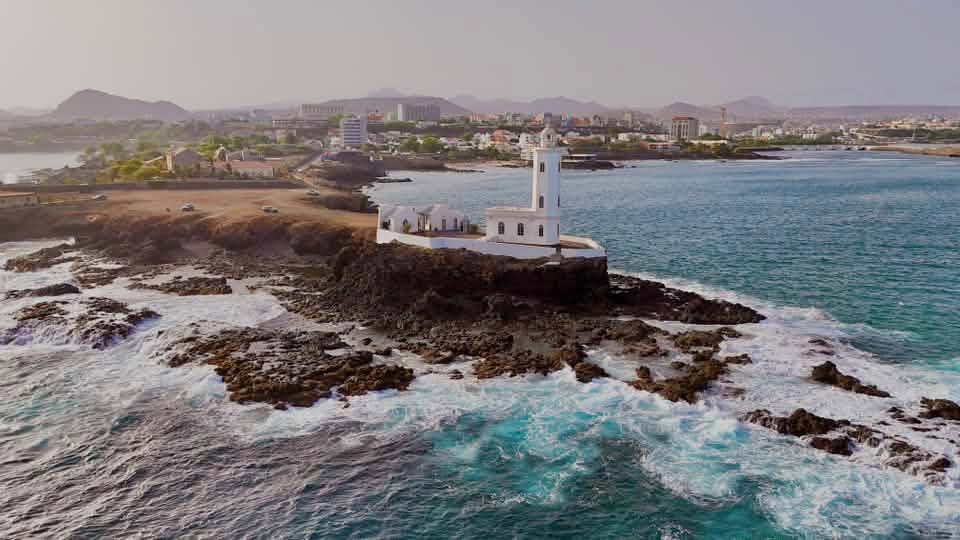
- Capital Praia: the country's political and economic center - an urban character with a different safety profile than the resort islands.
- Pure culture: Batuko and Funaná, two of Cape Verde's most important music styles, have their roots on Santiago.
Santiago at a glance.
- Location
- Sotavento group, Cape Verde's largest island
- Main towns
- Praia (capital) · Cidade Velha (UNESCO) · Tarrafal · Assomada
- Airport
- Nelson Mandela Int'l (RAI), 2,100 m runway - since 2005, no direct flight from Europe
- Language
- Portuguese (official) · Kriolu (everyday), often in the local "Badiu" variant here
- Currency
- Cape Verdean escudo (CVE), fixed peg to the euro: €1 = 110.265 CVE
- Time zone
- UTC-1 (no daylight saving time in Cape Verde)
- Power
- 220-230 V, plug type C/F - travelers from continental Europe usually need no adapter; UK, US, and most other visitors will need one
- Highest point
- ✓ Verified
Pico de Antónia, roughly 1,392 m
Who is Santiago right for?
Santiago runs on a different rhythm than Sal or Boa Vista - an island for your head and your legs, less for the sun lounger. An honest look before you book.
A good fit for...
- History and culture enthusiasts - Cidade Velha is Cape Verde's only UNESCO World Heritage Site
- Hikers (the Serra Malagueta and other mountain regions)
- Anyone who wants to experience genuine, urban Cape Verdean daily life in the capital, Praia
- Combining with a second, beach-focused island like Sal or Boa Vista
- Music enthusiasts - the cultural roots of Batuko and Funaná lie here
Less of a fit for...
- Pure beach holidaymakers - Santiago has only a few, mostly simpler beaches (Tarrafal is the exception)
- Spontaneous travelers - there's no direct flight from Europe, and getting here takes noticeably longer than to Sal
- Anyone who wants to stay exclusively within resort grounds - large parts of Santiago are a "real" island with no tourism infrastructure
- Anyone expecting the dry desert landscape of the Barlavento islands - Santiago is green and mountainous in stretches
When is the best time to visit?
Because of its mountain regions, Santiago's climate is noticeably more varied than Sal's or Boa Vista's - ranging from arid to lush and green depending on elevation.
The annual average in Praia is around 27°C. Rainfall is concentrated between August and October. November through July is considered the best time to visit.
Climate zones by elevation
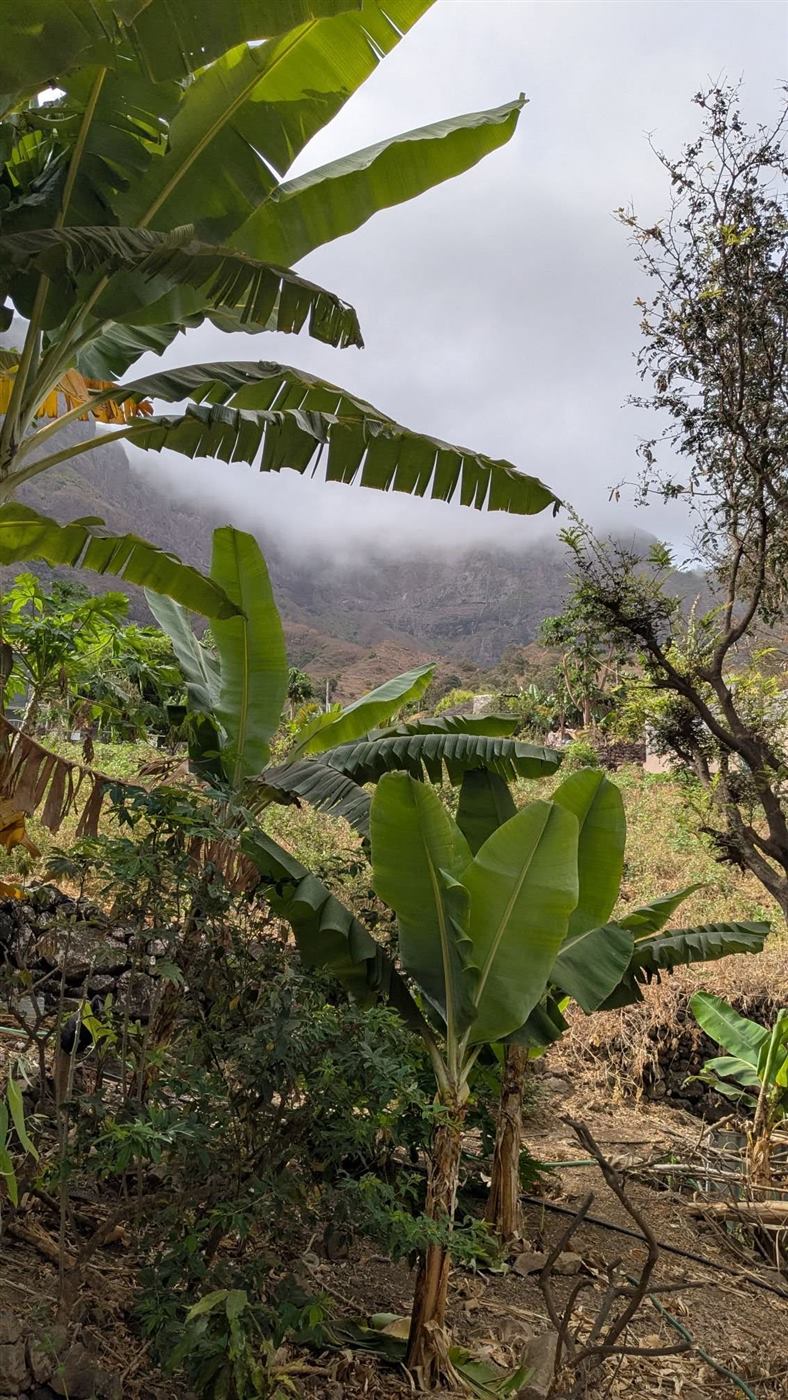
Unlike the flat Barlavento islands, Santiago has pronounced altitude climate zones because of its mountains: the coast (below 100 m) is arid and dry, from around 200 meters it becomes increasingly fertile and green, and above 500 meters - for example in the Serra Malagueta - a noticeably more humid, cooler climate prevails with significantly more rainfall than on the coast. That's why Santiago looks so much greener in stretches than Sal or Boa Vista.
Swimming on Santiago.
Honestly: beaches are a side note on Santiago, not the main reason to visit. These four are still worth a trip.
Praia de Tarrafal
A sheltered bay in the north of the island, by far the best-known and most beautiful beach on Santiago - fine sand, calm water, a small fishing harbor. Often combined with a visit to the town of the same name and its history (see Sights).
Quebra Canela
A semicircular bay right in Praia, with shallow, gently sloping water - popular with locals and families, easily reached directly from the capital.
Prainha
Right next to Quebra Canela, especially popular with Praia residents on weekends - more a place for authentic everyday life than a postcard-perfect tourist spot.
Praia Baixo
An untouched, barely developed beach away from the capital - and also one of the places where conservationists have documented sea turtle poaching (see Nature & Protected Areas). Not a classic swimming beach, but an authentic contrast to Tarrafal and Quebra Canela.
Green instead of desert: on Santiago too, the landscape changes dramatically with elevation - a contrast otherwise mainly found on Santo Antão.
Santiago is also a conservation story.
Three nature parks, a Ramsar wetland, and a bird species found nowhere else on Earth - Santiago's mountains are more than a green backdrop for hikes.
Parque Natural da Serra Malagueta
774 ha, split across three municipalities (Santa Catarina 302 ha, São Miguel 436 ha, Tarrafal 36 ha), with the summit at 1,064 m located in São Miguel. The mountain formation emerged roughly 2.4-2.9 million years ago. Documented so far are 124 plant species (28 of them endemic, including Limonium lobinii found exclusively here) and 19 bird species, eight of them endemic - introduced species like Lantana camara increasingly threaten the endemics.
Parque Natural Serra do Pico d'Antónia
Around 2,948 ha surrounding the island's highest point at 1,392 m - with, according to the environment ministry, an above-average share of Cape Verde's endemic plant species. Because fast-moving fog banks are common in the highlands, a local guide on the ascent is a safety matter, not just a recommendation.
Parque Natural da Baía do Inferno e Monte Angra
At around 21,096 ha (3,626 ha land, 17,470 ha sea), the largest of Santiago's three protected areas by area - designated in April 2021 and still missing from many older overviews. That means the island now has three classified nature parks, not the two often cited.
Lagoa de Pedra Badejo Ramsar Site
666.07 ha, listed as a wetland of international importance since July 18, 2005 - two coastal lagoons plus the catchment of a watercourse up to the Poilão reservoir (not to be confused with the tree of the same name near Boa Entrada). When water levels are sufficient, the reservoir is an important resting ground for migratory birds, but it has also run completely dry at times - most recently around 2018.
A bird species that exists only on Santiago
The garça-vermelha (Ardea purpurea bournei), a subspecies of the purple heron, occurs in Cape Verde exclusively on Santiago and is considered critically endangered - mainly due to trapping and egg collecting. Two breeding grounds are documented: the Poilão tree near Boa Entrada and, separately, a colony discovered in 1991 in mahogany trees near Banana in the Ribeira Montanha, which at times held around 40 adult birds. The NGO Lantuna has since identified 13 smaller colonies in northern Santiago, from São Domingos to Tarrafal.
Sea turtles: Santiago's lesser-known downside
Unlike on the resort islands, catching and eating sea turtles on Santiago is, according to the NGO Lantuna (as of 2021, no more recent public figures available), a real problem - in a single July, 52 animals were caught and killed in Porto Mosquito alone, and a count across three beaches found over 100 shells as evidence of poaching. Catching and eating turtles carries fines or prison sentences. Praia da Ribeira da Prata near Tarrafal is one of the most important nesting beaches (main season July-October) and now has a guarded viveiro (rearing station).
More than just the beach.
Cidade Velha
Cape Verde's only UNESCO World Heritage Site (reference number 1310, inscribed 2009, core zone 209.1 ha, buffer zone 1,795.6 ha): the first European colonial town in the tropics, founded in 1462 as Ribeira Grande. On show are the ruined Fortaleza Real de São Filipe (1587-1593, roughly 120 m above the sea), the church Nossa Senhora do Rosário (1493-1495, the oldest surviving building, with a rare Manueline side chapel) and the historic pillory (Pelourinho, a marble column from 1512 or 1520) from the era of the slave trade - in 1466, the town received the royal monopoly on the slave trade. Around 12 km, or a 30-minute drive, from Praia.
Serra Malagueta
A nature park in the island's north (founded 2005, around 774 hectares) with a roughly 8 km hiking trail up to the summit area at about 1,064 m - noticeably greener and cooler than the coast. An information center serves as the starting point, and guided tours can be booked.
Museu da Resistência, Tarrafal
Contrary to common accounts, the former Campo de Concentração do Tarrafal prison camp was not operated continuously until 1974: the first phase (from April 23, 1936, with the first 152 prisoners arriving October 29, 1936) targeted mainly Portuguese anti-fascists and ended with the camp's closure in January 1954. It only reopened in June 1961, as "Campo de Trabalho de Chão Bom" - this time for independence-movement prisoners from Angola, Guinea-Bissau and Cape Verde (first arrivals February 1962) - until its final closure on May 1, 1974. Death toll estimates vary by source between 36 and 37. Today the site is a memorial museum (daily 9am-5pm, until 1pm on public holidays), on Cape Verde's UNESCO tentative list since 2016, and the country's most-visited museum.
Poilão de Boa Entrada
A few kilometers from Assomada, in the green valley of Boa Entrada, stands the largest tree in the entire archipelago - a kapok tree (Poilão) with a trunk circumference of 28.15 m, measured in 2020 (at 1.30 m height). Local tradition holds it's over 500 years old, though the more scientifically defensible figure is "over 300 years" - no precise age determination exists. The tree is a protected natural monument and, thanks to a year-round spring, keeps the valley around it lushly green; it's also listed as an Important Bird Area as a breeding site for the critically endangered purple heron subspecies (Garça-vermelha), found only on Santiago. A small park with steps and paths has since been built around it.
Photogenic spots
Cidade Velha is most striking in the morning, when the Fortaleza ruins and the cathedral ruins sit in soft light. From the summit area of the Serra Malagueta, clear days offer a panoramic view over much of the island. The Pelourinho in Cidade Velha is one of the most historically significant - and most photographed - single objects in Cape Verde.
That many people visited Cidade Velha in 2025 - up 29.2% on the year before. 76.5% of them were foreign visitors; visitor numbers are strongly seasonal, with February the strongest month and September the weakest.
Three towns, three faces.
Santiago is more than Cidade Velha - Praia, Tarrafal and Assomada show three completely different sides of the island.
Praia
Cape Verde's political and economic center, and its capital since 1770 - after Ribeira Grande (Cidade Velha) had been repeatedly raided by pirates and privateers for centuries, including a particularly severe attack by the English privateer Francis Drake in November 1585. The historic center is the "Plateau" (Platô) on a raised plateau, home to the long-running Mercado Municipal (fruit, spices, since 1924) - not to be confused with the separate Sucupira Market for textiles and household goods.
In the evening the Plateau is often quiet; the real nightlife plays out mainly in Achada de Santo António and the "upscale" Palmarejo - though the Plateau itself still hosts "Quintal da Música," one of the country's oldest live-music venues.
As the country's largest city, Praia has a different safety profile than the resort islands - see Safety & Health further below.
Tarrafal
A fishing town in the island's north with Santiago's most beautiful beach and the former prison camp Campo de Concentração do Tarrafal, now a memorial museum (see Sights) - a combination of relaxation and history that's typical of the island.
Assomada
The island's second-largest town, set in the fertile highlands. Known for its large open-air market (traditionally Wednesdays and Saturdays), where everything from livestock to household goods is traded - an authentic glimpse of rural daily life away from the coast.
What there is to do on Santiago.
Hiking in the Serra Malagueta
The roughly 8 km main trail climbs to about 1,064 m, with panoramic views over much of the island - moderate difficulty, guided tours bookable, starting point at the nature park's information center.
History tour through Cidade Velha
Half a day is enough for the Fortaleza ruins, the church Nossa Senhora do Rosário and the historic Pelourinho - most striking with a guide who can place the town's role in the Atlantic slave trade in context.
Sucupira Market in Praia
The central, often chaotically busy aluguer hub and trading post of the island, in the Plateau district - textiles, household goods and more, plus the island's most important shared-minibus hub for trips into the interior. Not to be confused with the separate Mercado Municipal for fruit and spices. An authentic glimpse of everyday Cape Verdean commerce, not a tourist souvenir market.
Experiencing Batuko, Funaná & Tabanka
Santiago is considered the cradle of these Cape Verdean art forms - Batuko (traditionally performed by groups of women with cloth-bundle percussion), Funaná (accordion and ferrinho scraper), and the Tabanka, a syncretic street procession with drums honoring Catholic saints that traces back to May 3rd (Santa Cruz) and is now recognized as part of Cape Verde's intangible cultural heritage. Main Tabanka festival season: May through late July.
Climbing the Pico de Antónia
At roughly 1,392 m, the island's highest point and more demanding than the Serra Malagueta - starting points include Rui Vaz. Because fast-moving fog banks are common in the highlands, a local guide here isn't just recommended, it's a safety matter.
The Rabelados of Espinho Branco
An isolated community in the island's interior that withdrew into the highlands starting in the 1940s in protest against church modernization reforms and colonial rule, and still maintains a traditional way of life today - also described academically as an African "quilombo." A visit with a local guide opens up crafts and a way of life found nowhere else in Cape Verde.
Road trip through the highlands
The route Praia - São Domingos - Assomada - Tarrafal links coast, fertile highlands and mountain villages - the classic way to experience the island's landscape diversity in a single day.
Swimming at Praia de Tarrafal
The island's most beautiful beach pairs well with a visit to the memorial museum in town - a day combining history and relaxation.
Quiet highlands at Rui Vaz
Cool mountain climate at around 800 m, denser vegetation and significantly more endemic plant species than the rest of the island - Rui Vaz and the adjacent Pico de Antónia together form one of Santiago's two most significant mountain ecosystem areas. An insider tip for anyone seeking quiet, away from Praia.
Parque Natural da Baía do Inferno e Monte Angra
Santiago's newest and largest protected area (since 2021, around 21,096 ha) on the coast - still barely developed for tourism, and precisely for that reason a destination for travelers who want to get off the well-trodden routes. Check locally beforehand for current access options.
Insider tip
◐ Community valueIf you searched in vain on Sal or Boa Vista for a cooking class or pottery workshop, you'll have better luck on Santiago - the island is considered the country's most culturally rewarding region. A classic catxupa cooking class here is more easily found as a nationwide bookable option than as a Santiago-specific fixture. Ask locally for current, specific offerings, since availability changes constantly.
What "Badiu" really means
Santiago's residents proudly call themselves "Badius" - a term originally derived from the Portuguese "vadio" (vagrant/vagabond). Colonial rulers used it disparagingly for escaped and freed enslaved people who built their own communities in the island's rugged highlands. Today "Badiu" is a positively reclaimed symbol of resilience and African roots - its counterpart is "Sampadjudu," used for residents of the northern Barlavento islands.
Cachupa Rica instead of Cachupa Pobre
The national dish comes in two worlds: Cachupa Rica is cooked with various meats (pork, beef, chicken, sausage) and was traditionally reserved for wealthier families, while Cachupa Pobre comes with vegetables or fish - both variants are widely available on Santiago. Also worth trying: Búzio, braised or grilled sea snails, a regional specialty of the island.
That's the size of the Parque Natural da Baía do Inferno e Monte Angra - Santiago's third protected area since April 2021, alongside Serra Malagueta and Pico d'Antónia, though it's still missing from many older overviews.
How much time should you give Santiago?
Three sample rhythms as a guide - not a rigid plan, but a template to adapt.
Short trip / stopover
- Day 1: Arrival, explore Praia (Plateau, Sucupira Market)
- Day 2: Full-day trip to Cidade Velha
- Day 3: Road trip toward Tarrafal (beach & memorial museum), departure
History, culture & nature
- Day 1-2: Arrive, explore Praia, settle in
- Day 3: Cidade Velha - take your time at the UNESCO World Heritage Site
- Day 4: Hiking in the Serra Malagueta
- Day 5: Road trip via São Domingos and Assomada (check market days) to Tarrafal
- Day 6: Tarrafal: beach & memorial museum
- Day 7: Rest day in Praia, departure
Combined with island hopping
- Week 1: as above - take your time with history, culture and nature on Santiago
- Week 2: domestic flight to Sal or Boa Vista for beach, water sports and relaxation - a worthwhile addition, since Santiago itself has only a few notable beaches (see "Who is Santiago right for?" above)
Arrival & getting around.
What actually matters after landing - entry requirements, cash, SIM cards and getting around the island.
Entry & airport tax (RAI)
Citizens of the EU, the UK, the US and Canada can enter visa-free for stays of up to 30 days; most other nationalities get a visa on arrival (Australia, for example, falls into this category) - check current requirements for your passport before you travel. Regardless of visa status, online pre-registration via the official EASE portal is mandatory before departure, including the airport security tax (TSA) of currently 3,400 CVE (roughly €31) - paying online at ease.gov.cv is usually cheaper and faster than paying at a counter on arrival.
Aluguer (shared minibuses)
On Santiago, known as "Hiace" or "Yasi" (after the vehicle model) - informal shared minibuses and pickups that run fixed routes and leave once full. Pay the driver in cash, in escudos; a rough guide is 100 CVE per 7 km on paved roads.
Money & ATMs
Cards on the Maestro/Cirrus network work reliably at ATMs; European V-Pay debit cards don't work everywhere, and not every international card network is accepted at every machine - carry a Visa or Mastercard credit card as a backup, plus some cash. ATMs also have daily withdrawal limits.
Getting a local SIM
Carriers Alou and Unitel T+ operate nationwide and have shops in Praia as well. Consider an eSIM as a backup too.
Car rental & driving license
Cape Verde drives on the right, as in continental Europe and the US. Several national authorities explicitly recommend carrying an International Driving Permit alongside your national license - for example, Germany's Foreign Office does, while other sources (including rental companies) don't treat it as mandatory. On Santiago a rental car pays off far more than on Sal or Boa Vista - this is the country's largest island, and the mountainous interior is hard to reach by aluguer alone. For the steep side roads in the highlands (Rui Vaz, Serra Malagueta), a 4x4 is clearly recommended. Several local and international providers have offices in Praia; filling stations from the two national networks, Enacol and Vivo Energy (Shell), line all the main roads but are sparser in the interior - fill up before longer trips.
Tipping & etiquette
Unlike in many countries, there's no fixed tipping culture. Voluntary rounding-up or roughly 5-10% for good service in restaurants is common, though not expected - some places already add a service charge to the bill.
Terminal Marítimo: the island group's ferry hub
The port of Praia is the central hub for the CV Interilhas ferries serving the Sotavento group - if you're traveling from Santiago to Fogo, Brava or Maio, you'll almost always go via Praia. The "Linha Sotavento" (Maio-Santiago-Fogo-Brava, 3x/week) is served by the Kriola (164 passengers, 66 t of cargo; Santiago-Fogo around 4 hours, Fogo-Brava under 1 hour, Maio-Santiago under 2 hours). The network is weather-dependent and has already been out of service for extended periods more than once - in 2025 after a ship breakdown, and in February 2026 due to rough seas on the approach to Fogo. Tickets via cvinterilhas.cv/buy, at the terminals, or through agents - arrive at the port at least 1.5 hours before departure and build in a time buffer for onward travel.
Onward travel by domestic flight
Praia (Nelson Mandela Int'l) is the operational base of the new state airline CVsky, which has run the domestic network since late March/early April 2026 with two ATR 72-600 aircraft and around 159 flights a week - predecessors like Binter Cabo Verde and TICV/Bestfly Cabo Verde no longer exist. For onward travel to Sal, Boa Vista or the smaller islands, usually the more reliable alternative to the ferry.
Water is not a given on Santiago either
Thanks to its mountain regions, Santiago has more natural water sources than the arid Barlavento islands like Sal or Boa Vista - yet Praia still depends heavily on the Palmarejo desalination plant, not primarily on spring water. In May 2026, a technical fault there knocked out supply to entire parts of the city; by August 2026 the plant was, according to the operator, running at only 3 of 4 production lines (roughly 75% capacity) - expansion with a new plant at Palmarejo Grande is underway. Mindful water use on the ground - short showers, reusing towels - remains worthwhile precisely for that reason.
What you should watch for.
General safety
Germany's Foreign Office explicitly names Praia and Mindelo as the country's two largest cities, where pickpocketing and occasional muggings occur more concentrated than on the touristic resort islands - a different safety profile than, say, Santa Maria on Sal. Within Praia, the Plateau, Prainha, Achada Santo António and Palmarejo are considered comparatively unproblematic during the day, while neighborhoods like Terra Branca have repeatedly been named in press reports in connection with muggings - take extra care there after dark. Otherwise, the usual big-city precautions apply: don't carry valuables openly, stick to busy streets at night, and check your own country's current travel advisory before departure.
Health & vaccinations
The usual travel vaccinations (including tetanus/diphtheria, hepatitis A) are recommended - seek medical advice before you travel. Cape Verde has been officially malaria-free since 2024. In 2023/2024 there was a nationwide dengue outbreak (around 19,000 cases, 8 deaths, declared over in January 2025) with a growing concentration in the capital Praia as the year went on - over 6,000 confirmed cases were counted there alone; in the early outbreak phase, Fogo had been hit hardest instead. Check current information before your trip and plan for mosquito protection.
Medical care
As the capital, Praia has the country's best medical infrastructure. For more serious cases, patients are still often evacuated to Europe - which is exactly why travel health insurance with real medical evacuation coverage isn't an optional extra for a Cape Verde trip, it's the core of the coverage.
Lost your passport? Praia is where you go
Praia is home to every foreign embassy as well as Cape Verde's Direção de Estrangeiros e Fronteiras (DEF), responsible among other things for residency matters. Anyone who loses their passport on any Cape Verde island will almost always end up here for replacement documents and official paperwork - one more reason to keep digital passport copies on hand before anything happens.
Where to stay?
Deliberately without invented individual prices: prices shift constantly by season and provider. These three categories help with orientation - check current prices via the booking links below.
Budget
Guesthouses & Pensions- Mainly in Praia, also in Tarrafal and Assomada
- Simple rooms, often with kitchen access
- A good choice for longer stays / digital nomads
Mid-range
City Hotels & Aparthotels- Central location in Praia, usually in or near the Plateau district
- Urban character rather than beach resort
- The island's widest selection
Premium
Business & Boutique Hotels- Mainly in Praia, often geared toward business travelers
- No classic all-inclusive resort offering like on Sal/Boa Vista
- Popular with independent and business travelers
Current prices and availability for all three categories are available directly from the respective providers.
What does a week on Santiago cost?
€ Price guideGuide prices per person per week on the ground (excluding flights), heavily dependent on season and travel style - for rough orientation, not an exact quote.
| Category | Budget | Mid-range | Comfortable |
|---|---|---|---|
| Accommodation | Guesthouse, shared/basic room | Mid-range hotel, central | All-inclusive resort |
| Food | Local food, self-catering | Mix of restaurants & self-catering | Full board / upscale restaurants |
| Local transport | On foot, occasional aluguer (shared minibus) | Taxi & occasional rental car | Rental car throughout / private transfers |
| Activities | Beach, free excursions | 1-2 tours per week | Diving, water sports courses, excursions |
Planning more than just a vacation?
Family travel, digital nomad life, or real estate interest - three topics that go beyond ordinary trip planning.
Santiago with kids
Quebra Canela in Praia, with its gently sloping water, is the island's most hassle-free family beach. For a pure beach holiday with kids, though, Sal or Boa Vista and their resort infrastructure are usually the more practical choice.
Best Time & Climate →Digital nomad life on Santiago
Cape Verde has its own legally established remote-work residency program under Law 27/X/2023. Starlink has also been available nationwide since December 2024 - as the capital, Praia offers the best infrastructure (banks, government offices, internet) of any Cape Verde island.
Digital Nomads Guide →Buying property on Santiago
As the seat of government, administration and most banks, Praia is often a more practical base for business and investment plans than the resort islands. A NIF tax number, an independent lawyer and a land registry (Registo Predial) entry are mandatory here too, before any payment.
Available soon (EN)How do you get to Santiago?
There's still no direct flight to Santiago from most of Europe - but since 2026 there are direct connections from Porto, which can be worthwhile for travelers already routing through Portugal.
From Europe
⚠ Subject to changeThe standard route goes via Lisbon with TAP Air Portugal, sometimes codeshared with other European carriers - the Lisbon-Praia flight alone takes around 4 hours 20 minutes. Including the connection, total travel time from most of Europe runs to roughly 9.5 hours, sometimes longer depending on the connection. Porto has been a second alternative since October 2025: easyJet already flies direct to Praia from there, and TAP Air Portugal joined on July 2, 2026 - a more direct option for travelers already passing through Portugal.
Via Morocco or island hopping
Royal Air Maroc serves the route via Casablanca from various European cities (including Frankfurt and Munich). Alternatively: fly to Sal first and continue with a domestic flight - domestic flights have been operated since late March/early April 2026 by the new state airline CVsky (previously Binter Cabo Verde/TICV, which ceased operations in 2024) - worthwhile if you're planning island hopping anyway.
What actually helps on Santiago.
Not a generic travel packing list, but what specifically makes a real difference on Santiago.
- Sturdy, closed-toe shoes for hiking in the Serra Malagueta - sandals aren't enough here
- A light rain jacket for the rainy season (August-October), especially in the mountain regions
- High-SPF sunscreen - despite the cooler mountain air, sun intensity stays high
- Cash in escudos plus a Maestro/Cirrus-compatible backup card (see Money & ATMs above)
- Your national driving license - if you're renting a car, also consider an International Driving Permit, especially relevant here given the island's size
- A light mask for Bruma Seca season (December to February) if you're sensitive to dust
- EASE confirmation and return ticket, both digital and printed, easily accessible
- Slightly smarter clothing for restaurants in Praia - the dress code there is often more urban than on the beach islands
Sources & the state of this page
- Porto flight connections corrected: the German original stated in several places that easyJet had flown Porto-Praia "since April 1, 2026" - that was a mislinked date. easyJet has actually served Porto-Praia since October 2025 (part of an expansion from the original Porto-Sal route running since October 2024, to Boa Vista/Praia/São Vicente); March 30, 2026 was instead the start date of a separate, new Porto-São Vicente route. TAP Air Portugal joined the Praia route on July 2, 2026. Confirmed via several independent Portuguese aviation portals (including publituris.pt, echoboomer.pt, easyjet.com/news).
- Cidade Velha UNESCO World Heritage listing: inscribed in 2009 under the official name "Cidade Velha, Historic Centre of Ribeira Grande" - confirmed via whc.unesco.org.
- Cidade Velha 2025 visitor numbers (28,964, +29.2% year-on-year, 76.5% foreign visitors): drawn from statistics by Cape Verde's Instituto do Património Cultural (IPC), reported by the Cape Verdean daily expressodasilhas.cv (Feb 13, 2026) - matches exactly the figures cited on this page.
- Tarrafal prison camp (two phases, 1936-1954 and 1961-1974, with a genuine closure gap in between): confirmed through multiple independent sources (including the Museu do Aljube in Lisbon, Wikipedia's sourcing) - an earlier version of this page claiming continuous operation from 1936-1974 was incorrect and has been corrected accordingly.
- Poilão tree trunk circumference, 28.15 m (measured Dec. 2020): sourced from monumentaltrees.com, a specialized community-based dendrology database - not an official source, but with a concrete measurement date, so preferred over a vague "over 500 years" age claim that couldn't be substantiated.
- CVsky as the new domestic-flight operator: confirmed - the state airline began commercial operations on March 29, 2026, replacing the previously named operators; sourced via capeverdeislands.org and plataformamedia.com, among others.
- Sea turtle poaching figures (52 animals/July in Porto Mosquito, 100+ shells found): date from 2021 - despite searching, no more recent publicly available figures were found, so this is explicitly labeled "as of 2021" rather than presented as current.
- Praia climate data (annual average ~27°C): Wikipedia's climate table cites a 24.4°C annual mean alongside an average daily high of around 27°C - the 27°C figure used on this page therefore refers more to the daily high than the 24-hour average. Best time to visit unified to November through July.
- Dengue case distribution corrected: an earlier draft of this page's research cited "Fogo ~59%, Santiago ~37%" as the outbreak's case distribution and treated it as officially confirmed. That figure is in fact only a snapshot from the early outbreak phase (as of June 2024, per IFRC/ReliefWeb). Later situation reports showed a marked shift toward the capital Praia: by Oct. 15, 2024, 6,014 of 8,152 confirmed cases (73.8%) were in Praia alone (expressodasilhas.cv). The outbreak was declared over in January 2025 with a cumulative total of around 19,000 cases and 8 deaths (observador.pt, Mar. 10, 2025). Text corrected accordingly.
- Cape Verde entry policy, added for the English edition: independently verified via Wikipedia's "Visa policy of Cape Verde" - the 30-day visa waiver (with mandatory EASE pre-registration) explicitly covers all EU member states plus the UK, the US and Canada; most other nationalities (e.g. Australia) receive a visa on arrival rather than a full waiver. The German-language original only states this for German/EU travelers; it has been broadened and specified here for an international readership rather than translated literally.
This is how our members see it.
Questions about Santiago.
Is Santiago safe to visit?
Generally yes, but as the country's largest city, the capital Praia has a different safety profile than the touristic resort islands - according to Germany's Foreign Office, pickpocketing and occasional muggings occur more concentrated here. Usual big-city caution is generally enough.
What is Cidade Velha and why is it worth seeing?
As Ribeira Grande, Cidade Velha was the first European colonial town in the tropics (founded 1462) and has been Cape Verde's only UNESCO World Heritage Site since 2009. On show: ruined fortifications, the region's oldest surviving church, and a historic pillory from the era of the slave trade.
Is there a direct flight to Santiago from Europe?
No - unlike Sal or Boa Vista, Santiago is usually reached via Lisbon (TAP) or with a connection in Morocco (Royal Air Maroc). Since October 2025 there have at least been direct flights from Porto (easyJet, with TAP added since July 2026). Alternatively, by domestic flight from Sal.
Do you need a rental car on Santiago?
Much more so than on Sal or Boa Vista - Santiago is the country's largest and most mountainous island, and the interior is hard to reach by shared minibus. For a road trip to the Serra Malagueta, Assomada and Tarrafal, a rental car clearly pays off.
How many days should you plan for Santiago?
2-3 days is enough for Cidade Velha and Praia. If you also want to hike and explore the island by road trip, plan for 5-7 days instead.
What's the story behind the prison camp in Tarrafal?
The former Campo de Concentração do Tarrafal didn't run continuously: a first phase (1936-1954) held mainly Portuguese anti-fascists, and after a closure, a second phase (1961-1974) held independence-movement prisoners from Angola, Guinea-Bissau and Cape Verde. Today the site is a memorial museum and has been on Cape Verde's UNESCO tentative list since 2016.
Is island hopping from Santiago worthwhile?
Yes - Santiago is connected to Sal and Boa Vista by domestic flights and works well for combining culture/history with a classic beach holiday on a second island. See the island-hopping guide for details.
Is there a rainy season on Santiago?
Yes, more pronounced than on Sal or Boa Vista - the rainy season is concentrated between August and October, especially in the mountain regions. The rest of the year stays mostly dry.
What is the Tabanka?
A syncretic street procession with African roots, drums and parades honoring Catholic saints - originating in the 18th century from celebrations by freed enslaved people on May 3rd. Main season is May through late July; recognized as Cape Verde's intangible cultural heritage since 2019, celebrated mainly on Santiago.
Who are the Rabelados?
An isolated community in Santiago's interior (including near Espinho Branco) that withdrew starting in the 1940s in protest against church reforms and colonial rule, preserving a traditional way of life - also described academically as an African "quilombo."
What does "Badiu" mean?
The self-designation of Santiago's residents, originally derived from the Portuguese "vadio" (vagrant) - a colonial term for escaped and freed enslaved people in the island's highlands, today positively reclaimed as a symbol of resilience and African roots.
Can you climb the Pico de Antónia?
Yes, at roughly 1,392 m the island's highest point, and more demanding than the Serra Malagueta - a guide is a safety matter here because of fog risk, not just a recommendation.
Can you take a ferry from Santiago to other islands?
Yes - the port of Praia is the central CV Interilhas hub for Fogo, Brava and Maio. Schedules are weather-dependent and change at short notice; tickets are available at the port office and sometimes online.
How many nature reserves does Santiago have?
Three: Serra Malagueta, Serra do Pico d'Antónia, and the Parque Natural da Baía do Inferno e Monte Angra, designated since April 2021 - the latter is still missing from many older overviews.
Which airline flies the domestic routes today?
Since late March/early April 2026, the new state airline CVsky (Linhas Aéreas de Cabo Verde). The predecessors Binter Cabo Verde and TICV/Bestfly Cabo Verde no longer exist - TICV ceased operations in 2024.
How to move forward.
Settle on arrival
No direct flight from Europe, but since October 2025 there are direct connections from Porto (easyJet, with TAP added since July 2026) - alternatively via Lisbon, or by domestic flight with the new state airline CVsky.
Jump to the getting-there overview →Prioritize Cidade Velha & the nature parks
Cape Verde's only UNESCO World Heritage Site and three nature parks fit comfortably into a week - the budget guides and accommodation tiers above help with initial planning.
Jump to accommodation tiers →Combine with a beach island
Santiago has only a few beaches - combining it with Sal or Boa Vista via domestic flight is the more sensible route for most travelers than visiting one island alone.
All islands at a glance →Ready for Santiago?
Compare current prices for flights, hotels and rental cars, or take a look at the other 8 islands first before you decide.