

Sal - The Sun Island, in detail.
Sal is most visitors' first contact with Cape Verde - and for good reason: it has the country's most reliable direct flight connections (currently from Germany and Portugal), the driest climate of all nine islands, and in Santa Maria one of West Africa's best-known beaches. Here's what you actually need for planning: beaches, climate, getting there, and costs - no marketing fluff.
Sal in 60 seconds.
- Best choice for first-time visitors: the most reliable direct flight connections of any Cape Verde island and the driest climate in the country.
- But: away from the beaches it's fairly barren - if you want hiking, volcanoes or traditional village life, islands like Santo Antão or Fogo deliver more.
- Three very different towns: Santa Maria (tourist hub), Espargos (real everyday life), Palmeira (small harbor town).
- Money: bring a Maestro/Cirrus-enabled card plus some cash - European V-Pay debit cards don't work reliably here, and not every ATM accepts every international card network.
- Safety: considered one of the safer islands in the country, including for solo travelers - normal precautions are enough.
Sal at a glance.
- Location
- Barlavento group, northeastern archipelago
- Main towns
- Espargos (administration) · Santa Maria (tourism)
- Airport
- Amílcar Cabral Int'l (SID), 3,000 m runway - under VINCI Airports concession since July 2023
- Population
- ✓ Verified
~33,000 (2021 census, INE Cabo Verde) - Highest point
- Monte Grande, 406 m - protected area (1,299 ha), ~8 km northeast of Espargos
- Language
- Portuguese (official) · Kriolu (everyday) · English/Italian common in Santa Maria
- Currency
- Cape Verdean escudo (CVE), fixed peg to the euro: €1 = 110.265 CVE
- Time zone
- UTC-1 (no daylight saving time in Cape Verde)
- Power
- 220-230 V, plug type C/F - travelers from continental Europe usually need no adapter; UK, US, and most other visitors will need one
- Tap water
- Treated via seawater desalination - many travelers still prefer bottled water
Who is Sal right for?
Sal is Cape Verde's most-visited island - but that doesn't automatically make it the right choice for everyone. An honest look before you book.
A good fit for...
- First-time visitors who want the simplest, most direct flight access
- Beach, water sports and kitesurfing fans
- Short trips (5-7 days), since little travel time is lost on the island itself
- Solo travelers, including women - Sal is considered one of the safer islands
- Anyone who wants a reliable, consistent climate with little rain risk
Less of a fit for...
- Hikers and nature lovers - Santo Antão or Fogo offer much more there
- Anyone looking for traditional Cape Verdean village life rather than tourist hubs
- Cultural travelers looking for cooking classes or craft workshops - the offering on Sal is thin (see the insider tip further down)
- Anyone expecting exclusively green, lush landscapes - Sal is mostly flat and arid
When is the best time to visit?
Sal has an arid, very consistent climate - almost no rain, warm all year round. The differences between seasons are smaller than in Europe or North America, but still noticeable.
The annual average is around 25°C, with September the warmest month (~28°C) and March the coolest (~23°C). Rainfall is minimal at around 91 mm a year. November through June is considered the best time to visit; April through June often offers the best value while weather remains reliable.
Weather phenomenon: Bruma Seca
Between December and February, a high-pressure system over the Sahara can carry desert dust across the entire Cape Verde archipelago ("Bruma Seca") - visibility noticeably hazes over, and in pronounced cases drops significantly according to Cape Verde's meteorological service. This can be unpleasant for people with respiratory issues; a light mask for sensitive days doesn't hurt.
The beaches of Sal.
Four beaches, four completely different characters - from family-friendly swimming to world-class kitesurfing.
Praia de Santa Maria
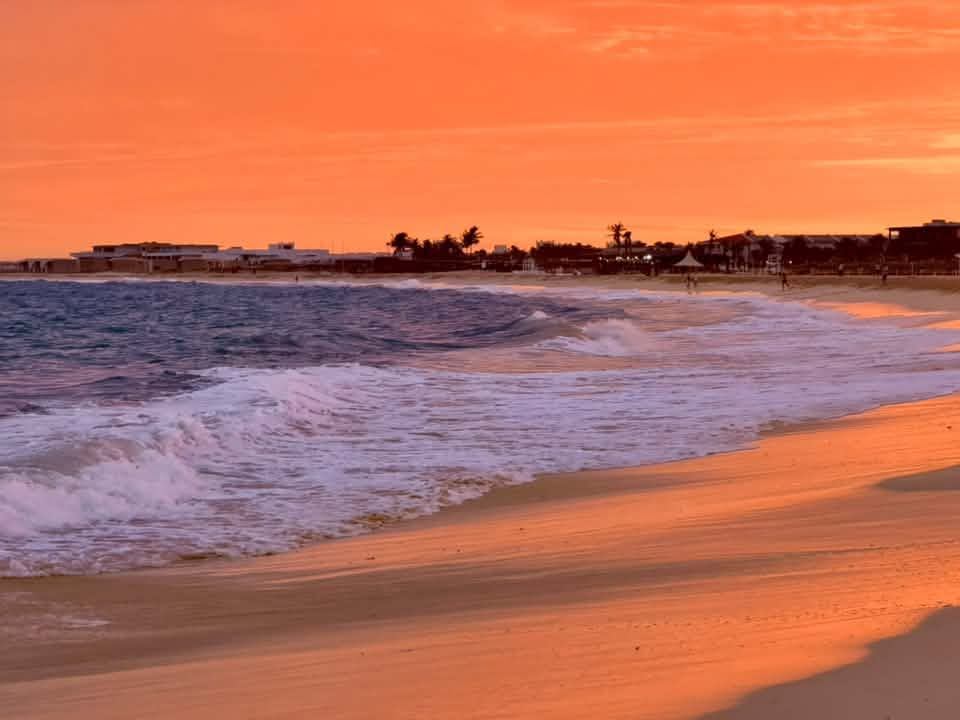
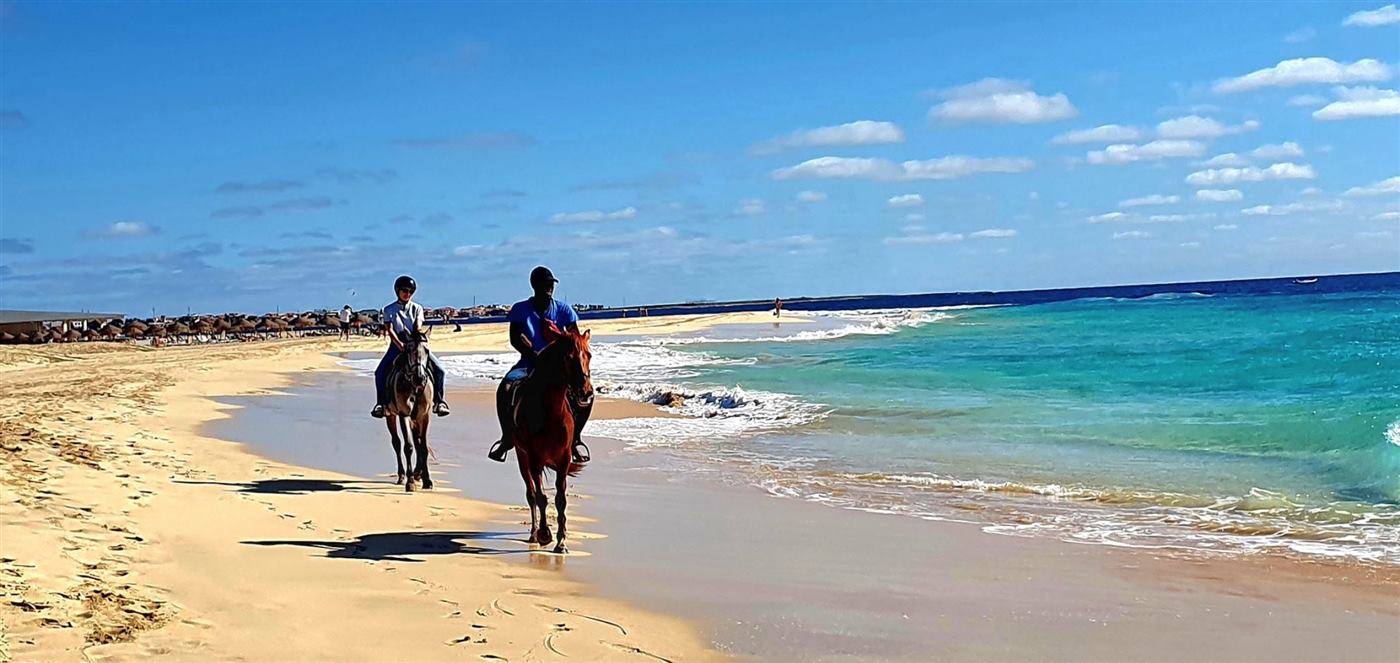
Over 8 kilometers of powder-white sand right at the town of the same name - Cape Verde's best-known beach. Calm, turquoise water, with restaurants, bars and Santa Maria's old fishing pier right on the doorstep.
Kite Beach
On the wind-exposed east coast, a short drive from Santa Maria. Flat water and steady, side-onshore wind make it ideal for both beginner and advanced kitesurfers.
Praia do Algodoeiro
Just east of central Santa Maria, with the same fine sand and sheltered water - but noticeably quieter and less crowded than the main beach.
A note on currents
Praia de Santa Maria and Praia do Algodoeiro are considered comparatively calm, sheltered swimming beaches. Ponta Preta and Kite Beach, by contrast, are deliberately wind- and wave-exposed - outside the marked kitesurf zones, extra caution is warranted there, especially for weaker swimmers and children.
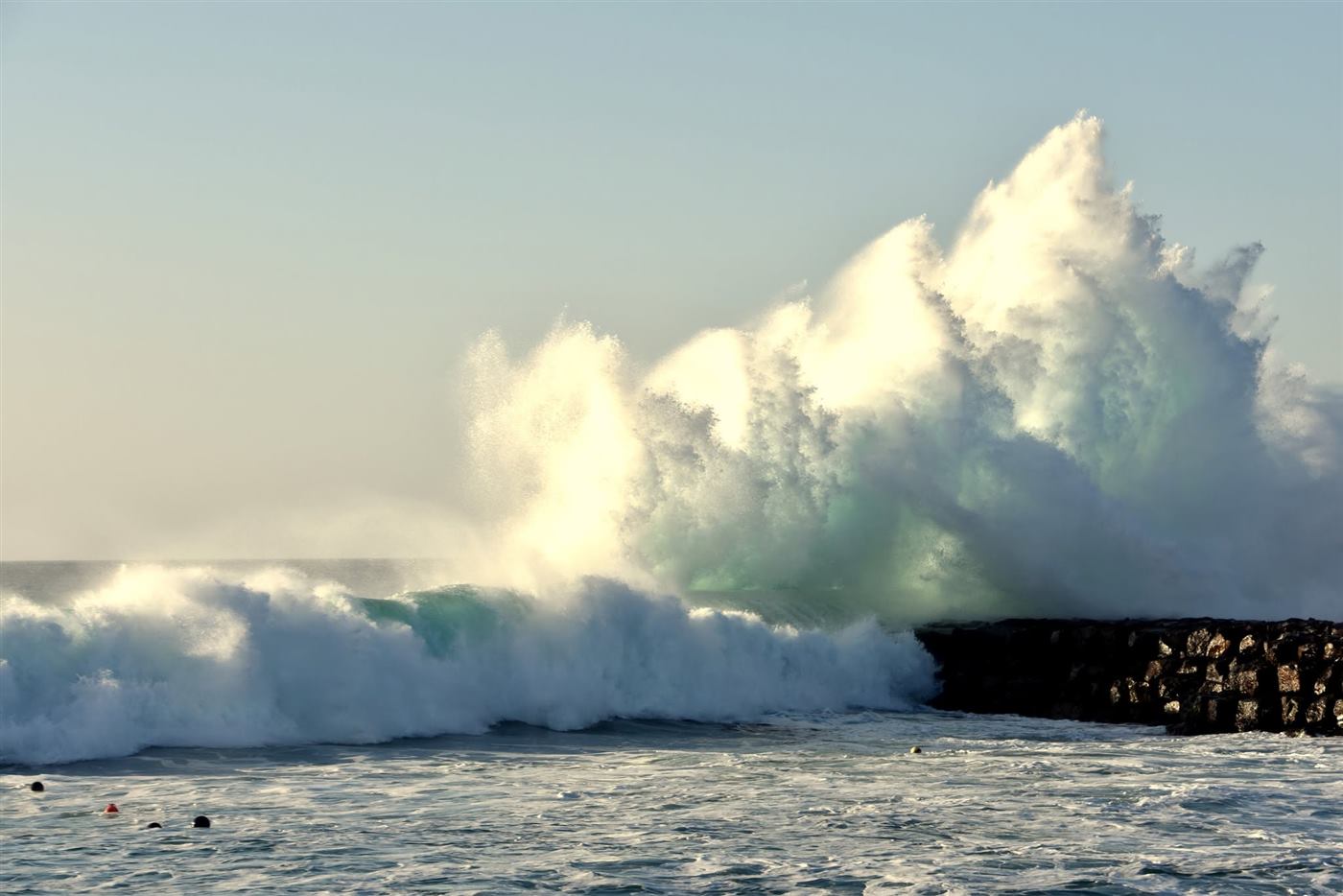
Flat, barren, dry - and underneath it all, a network of eleven protected areas that most Sal visitors never lay eyes on.
Sal is also a conservation story.
Eleven designated protected areas cover a significant share of the island and its coastal waters - from Cape Verde's only fully marine reserve to fossil dunes home to rare seabirds.
Reserva Natural da Baía da Murdeira
Originally delimited at 6,107 ha (182 ha land, 5,925 ha sea) by a 2014 decree, and since 2003 Cape Verde's only reserve with a fully marine protection category (not to be confused with protected areas that only cover partial sea sections). Protection covers a three-nautical-mile strip of sea, a 150 m strip of land along the entire bay, and Ilhéu Rabo de Junco - one of the country's most important seabird breeding sites. The boundaries were adjusted again in 2022 by decree (Decreto-Regulamentar No. 21/2022); the exact currently valid total area after that change could not be verified with certainty and is therefore not stated here. The bay is home to over 77 fish species, nurse sharks, and the rare cone snail Conus mordeirae, found only at Murdeira.
Serra Negra
At around 2,627 ha, the island's largest protected area: a 104 m-high ridge of fossil dunes, listed as a Key Biodiversity Area and Important Bird Area. It hosts one of West Africa's most significant colonies of the red-billed tropicbird (Phaethon aethereus) - according to University of Barcelona research, likely the species' most important breeding site in the region - as well as, at 2.4 nests per meter of beach, the highest loggerhead turtle nest density among Sal's most popular nesting beaches.
Costa da Fragata
Around 2,693 ha of dune landscape (346 ha land, 2,347 ha sea) - damaged in places by illegal sand mining. The main threats are unregulated vehicle and horse traffic, sand extraction and coastal development; uncontrolled kitesurfing and diving are also considered a risk to the dune vegetation.
Ponta do Sinó - a protected area that got smaller
In 2015, part of this coastal protected area was declassified under pressure from the growing tourism industry, shrinking its land area by 27 hectares. The boundaries have since been officially adjusted several times, most recently by decree in November 2025 - for the currently valid delimitation, the latest decree in Cape Verde's official gazette governs, not this historical figure. The area is now largely surrounded by resorts, and the once-extensive dunes have largely disappeared - an example of how protected status on Sal is no permanent guarantee.
Further protected areas & endemic species
Beyond the four listed above, seven further areas on Sal are protected, including the salt pans at Pedra de Lume and Santa Maria and several smaller hills. Botanically documented species include the critically endangered Withania chevalieri and Diplotaxis glauca, as well as the threatened Pulicaria diffusa, Limonium brunneri, Lotus brunneri and Arthrocnemum franzii - mostly concentrated in the island's arid protected areas.
More than just the beach.
Pedra de Lume
An extinct collapse crater about 900 m across, holding salt pans - the crater floor sits below sea level, with water rising from below rather than seeping in sideways from the sea, according to geologists. Floating without sinking is part of the experience (often marketed as "the second-saltiest water in the world" - an unsubstantiated marketing claim, not a scientific figure). Salt extraction here dates back to 1796; today's saltworks cover around 40 ha, with an estimated salt deposit of over 50 million tons.
Buracona ("Blue Eye")
A natural pool in the lava coastline with crystal-clear, deep-blue water - the "Olho Azul" effect is strongest when the sun stands steeply overhead, roughly between 11am and 1pm, with light entering from below through an underwater cave. That's also when most day-trip groups are there; if you prefer it quieter, come earlier for a swim in the tide pools. Usually accessed via Palmeira.
The salt industry's history at Pedra de Lume
From 1919, the French company Salins du Cap Vert took over salt production and in 1921/22 installed a roughly 1,100 m cable car from the crater rim to the harbor, plus a rail line - handling up to 25 tons of salt per hour. Operations closed in 1985/86; the rusting cable-car frames and quay barges are still visible today. Pedra de Lume has been on the UNESCO tentative list since 2004 - a World Heritage candidate, but not (yet) a World Heritage Site.
Baía da Parda ("Shark Bay")
Not at Murdeira, but about 3 km south of Pedra de Lume on the east coast: a shallow, sheltered bay where Project Biodiversity, together with Queen Mary University of London, studies juvenile lemon sharks - a documented nursery for the species. Harmless to visitors, and a popular day trip from Santa Maria.
Photogenic spots
Buracona is most rewarding around midday (roughly 11am-1pm), when the light is steepest and the "Olho Azul" effect glows strongest - though it's also the busiest time. Pedra de Lume looks most photogenic in the morning, before the sun gets too steep. Ponta Preta delivers spectacular kitesurf action shots in strong wind, while Praia de Santa Maria produces the classic postcard shots at sunset.
Three towns, three faces.
Sal is more than its beach - Santa Maria, Espargos and Palmeira show three completely different sides of the island.
Santa Maria
Founded in 1830 by Manuel António Martins and settled by herders and fishermen from Boa Vista - hence the old town's regular grid layout. Originally a fishing village, today it's the island's tourist heart, with a restaurant and nightlife strip along the beach promenade and the Mercado Municipal for a glimpse of everyday life beyond the restaurants.
The historic wooden pier ("Pontão"), where fishing boats traditionally dock each morning, was destroyed by a tropical wave on October 11, 2024 - the government declared a state of emergency in response. Rather than a repair, a full rebuild is underway: extended from 50 to roughly 120-124 m, widened from 12.5 to 14 m, costing around €8.9 million, financed by the World Bank, with a construction period of around 18 months - on schedule as of a March 2026 ministry statement. Once complete, it's intended to serve as a fishing harbor, viewing pier and leisure marina.
Espargos
The island's actual capital, about 3 km from the airport - the administrative and economic center, with banks, a post office and a health center. Anyone staying longer, working as a digital nomad, or relocating here often lives here rather than in touristy Santa Maria.
The name comes from the wild asparagus that originally grew on the island.
Palmeira
A small harbor town with the island's most important cargo and fuel port, plus a traditional market hall. A starting point for dives and the route to Buracona.
Palmeira is also a scheduled stop on Cape Verde's inter-island ferry network - though connections are frequently disrupted by weather and technical issues, so check the current schedule directly with the operator before you travel.
That was Sal's share of all hotel arrivals in Cape Verde in Q1 2026 - far ahead of the second-placed island, Boa Vista (19.9% over the same period). Few other islands in the country depend this directly on tourism.
What there is to do on Sal.
Whale & dolphin watching
Between December and May, humpback whales migrate through the waters around Sal and Boa Vista, peaking in March/April. Watching activities have been regulated since Portaria No. 16/2024 - a minimum distance of 80 meters, or 100 meters for mothers with calves. Seasonal tours run out of Santa Maria.
Diving & snorkeling
Clear water, reefs and wrecks offshore - several licensed dive schools in Santa Maria offer courses from beginner to advanced.
Quad & buggy tours
Through the desert-like landscape of the island's interior, often combined with a stop at Pedra de Lume or Buracona.
Deep-sea fishing
Possible year-round, including tuna and marlin - half and full-day charters depart from Santa Maria.
Learning to windsurf & kitesurf
Santa Maria and Ponta Preta rank among the most reliable wind spots worldwide - several IKO-certified schools offer trial lessons and multi-day course packages for beginners.
Catamaran tours
Half-day trips along the coast, usually with a snorkeling stop and the occasional dolphin sighting - a calmer alternative to a motorboat trip.
Turtle watching
Licensed since October 2024 (Decreto-Lei 50/2024): watching is allowed only with a certified guide, between 7pm and midnight, with no artificial light. Project Biodiversity had already recorded 12,500 nests on Sal by mid-season in 2023; from late August to early December there are daily 4:30pm talks at the rearing station near Hotel RIU Funana, usually right before the previous night's hatched nests are excavated.
Hiking in the Serra Negra
This 104 m-high ridge of fossil dunes in the island's south is listed as an Important Bird Area - home to one of West Africa's most significant red-billed tropicbird colonies. Best done with a local guide, to avoid disturbing sensitive breeding areas.
Insider tip
◐ Community valueIf you're specifically looking for a cooking class or pottery workshop on Sal itself, you'll struggle to find one - the offering of local culture and cooking classes is noticeably thinner here than on, say, Santiago or Santo Antão. A classic catxupa cooking class can currently be found mainly as a nationwide bookable option, not as a fixed Sal-specific offering. If experiencing this side of the country matters to you, factor that into which island you choose.
That's the length of the runway at Amílcar Cabral Airport - the country's largest airport infrastructure, with apron space for 10 aircraft at once. In 2025, Cape Verde's airports handled 3.4 million passengers combined, up 60% from 2022 - driven by 35 new routes added since VINCI took over the concession in 2023.
How much time should you give Sal?
Three sample rhythms as a guide - not a rigid plan, but a template to adapt.
Short trip / stopover
- Day 1: Arrival, settle in at Santa Maria, sunset on the beach
- Day 2: Pedra de Lume & Buracona as a half-day tour, afternoon at the beach
- Day 3: Praia de Santa Maria or Praia do Algodoeiro, relaxed wind-down
Classic beach holiday
- Day 1-2: Arrive, explore Santa Maria & nearby beaches
- Day 3: Pedra de Lume & Buracona
- Day 4: Visit Espargos, Mercado Municipal, everyday life away from tourism
- Day 5: Water sports or boat trip (seasonal whale/dolphin watching, diving, catamaran)
- Day 6: Quad/buggy tour into the interior or Shark Bay
- Day 7: Rest day at the beach, departure
Combined with island hopping
- Week 1: as above - take your time with all of Sal's beaches, sights and activities
- Week 2: domestic flight to Boa Vista or Santiago for a second island with a different character - especially worthwhile if hiking, culture or traditional village life also interest you (see "Who is Sal right for?" above)
Arrival & getting around.
What actually matters after landing - entry requirements, cash, SIM cards and getting around the island.
Entry & airport tax (SID)
Citizens of the EU, the UK, the US and Canada can enter visa-free for stays of up to 30 days; most other nationalities get a visa on arrival (Australia, for example, falls into this category) - check current requirements for your passport before you travel. Regardless of visa status, online pre-registration via the official EASE portal is mandatory before departure, including the airport security tax (TSA) of currently 3,400 CVE (roughly €31) - paying online at ease.gov.cv is usually cheaper and faster than paying at a counter on arrival.
Aluguer (shared minibuses)
The cheapest way to get between Espargos, Santa Maria and Palmeira - informal shared minibuses with no fixed schedule that leave once full. Pay the driver in cash, in escudos.
Money & ATMs
Cards on the Maestro/Cirrus network work reliably at ATMs; European V-Pay debit cards don't work everywhere, and not every international card network is accepted at every machine - carry a Visa or Mastercard credit card as a backup, plus some cash. ATMs also have daily withdrawal limits.
Getting a local SIM
Carriers Alou and Unitel T+ run officially confirmed shops right at Sal airport - also available in Santa Maria. Consider an eSIM as a backup as well.
Car rental & driving license
Cape Verde drives on the right, as in continental Europe and the US. Several national authorities explicitly recommend carrying an International Driving Permit alongside your national license - for example, Germany's Foreign Office does, while other sources (including rental companies) don't treat it as mandatory. Check your own country's current guidance, and when in doubt, bring both documents.
Tipping & etiquette
Unlike in many countries, there's no fixed tipping culture. Voluntary rounding-up or roughly 5-10% for good service in restaurants is common, though not expected - some places already add a service charge to the bill.
Water is not a given on Sal
Sal is one of the driest islands in Cape Verde and has virtually no natural fresh water. The utility Águas de Ponta Preta draws seawater through 13 coastal wells, desalinates it via reverse osmosis with energy recovery, and distributes it through a roughly 6 km network - wastewater is treated biologically and reused for irrigation. Growing tourism noticeably increases the strain on this system. Mindful water use on the ground - short showers, reusing towels - genuinely makes a difference.
The island's real bottleneck is waste, not water
Sal produces around 200 tons of waste a day, while the municipal collection fleet consisted of only a handful of vehicles for years. On July 4, 2026, the Câmara Municipal do Sal launched a separated-waste-collection project with a partner company aiming to divert over 80% of recyclables from landfill - explicitly because the island cannot support another landfill site.
What you should watch for.
General safety
Sal is considered one of the safer islands in Cape Verde, including for solo travelers. Normal precautions are enough: don't leave valuables unattended on the beach, agree on taxi fares beforehand. A recurring, usually harmless but annoying pattern is pushy street vendors trying to lure tourists to a "market" - a friendly but firm decline is usually enough.
Health & vaccinations
The usual travel vaccinations (including tetanus/diphtheria, hepatitis A) are recommended - seek medical advice before you travel. Cape Verde has been officially WHO-certified malaria-free since January 2024. In 2023/2024 there was a nationwide dengue outbreak (around 19,000 cases, 8 deaths, declared over in January 2025) - initially concentrated in Fogo, but shifting markedly toward the capital Praia on Santiago as the year went on - treat this as a general Cape Verde-wide travel-advisory note, not an elevated Sal-specific risk.
Medical care
Basic care is available at the health center in Espargos. For more serious cases, patients are often evacuated to Praia or directly to Europe - which is exactly why travel health insurance with real medical evacuation coverage isn't an optional extra for a Cape Verde trip, it's the core of the coverage.
Carry-on bag checks before departure
Germany's Foreign Office currently warns explicitly that travelers have repeatedly been detained at airport security for prohibited items in carry-on luggage - in particular, pocket knives/blades over 6 cm and pepper/defense spray are criminal offenses under Cape Verdean law, not simply a "confiscate and board" situation. This applies regardless of nationality, so check your carry-on carefully before you travel.
Current notice: gastrointestinal illness in Santa Maria
Since 2022, the European health agency ECDC has recorded a sustained cluster of shigellosis and other gastrointestinal infections among travelers returning from the Santa Maria area on Sal - over 1,000 confirmed and probable cases by March 2026, concentrated among guests of one particular all-inclusive hotel chain. A food- or waterborne source is suspected; the current infection risk is rated as moderate. Favor well-cooked, hot-served food, and see a doctor if diarrhea persists after your trip - mention your Cape Verde travel history.
Where to stay?
Deliberately without invented individual prices: prices shift constantly by season and provider. These three categories help with orientation - check current prices via the booking links below.
Budget
Guesthouses & Pensions- Usually in Espargos or away from the beach promenade
- Simple rooms, often with kitchen access
- A good choice for longer stays / digital nomads
Mid-range
Hotels & Aparthotels- Central location in Santa Maria, walking distance to the beach
- Usually with a pool, breakfast optional
- The widest selection, and the most in demand
Premium
All-Inclusive Resorts- Mainly north of Santa Maria & toward Murdeira
- Full board, water sports & entertainment included
- Popular with package travelers & families
Current prices and availability for all three categories are available directly from the respective providers.
What does a week on Sal cost?
€ Price guideGuide prices per person per week on the ground (excluding flights), heavily dependent on season and travel style - for rough orientation, not an exact quote.
| Category | Budget | Mid-range | Comfortable |
|---|---|---|---|
| Accommodation | Guesthouse, shared/basic room | Mid-range hotel, central | All-inclusive resort |
| Food | Local food, self-catering | Mix of restaurants & self-catering | Full board / upscale restaurants |
| Local transport | On foot, occasional aluguer (shared minibus) | Taxi & occasional rental car | Rental car throughout / private transfers |
| Activities | Beach, free excursions | 1-2 tours per week | Diving, water sports courses, excursions |
Planning more than just a vacation?
Family travel, digital nomad life, or real estate interest - three topics that go beyond ordinary trip planning.
Sal with kids
Praia de Santa Maria and Praia do Algodoeiro are the calmer, more sheltered beaches - while Ponta Preta and Kite Beach are deliberately wind- and wave-exposed (see the note on currents above).
Best Time & Climate →Digital nomad life on Sal
Cape Verde has its own legally established remote-work residency program under Law 27/X/2023. Starlink has also been available nationwide since December 2024 - Espargos is often a more practical base for longer stays than Santa Maria.
Digital Nomads Guide →Buying property on Sal
Sal is the island with the strongest interest from foreign buyers - which also makes it a target for disreputable sellers. Two documented cases show why a NIF tax number, an independent lawyer and a land registry (Registo Predial) entry before any payment matter so much: the "Sal Vista" case, and properties at Vila Verde Resort that passed to the bank Novo Banco after developer Tecnicil became insolvent (€92.9 million in debt stemming from the 2008 crisis) and are now being sold by the bank.
Available soon (EN)How do you get to Sal?
From Germany & Portugal
Currently, Sal's direct flights originate almost entirely from two countries. Germany: TUI fly flies direct from Düsseldorf, Frankfurt, Hannover, Munich and Stuttgart (pure flight time from Frankfurt is around 6 hours 15 minutes), with Condor adding a second direct option from Frankfurt - Lufthansa itself does not fly to Sal nonstop, so any booking under its name is a codeshare/interline connection. Portugal: easyJet and TAP Air Portugal both fly direct from Porto. For the 2026/2027 winter schedule, TUI fly's route includes a stop on Boa Vista rather than flying straight through - always check the current schedule before booking.
From everywhere else
Travelers from the UK, the US, and most other countries typically connect via Lisbon (TAP Air Portugal), via Amsterdam or another major European hub, or via a short inter-island hop from Boa Vista. easyJet's Porto-Sal route (up to six flights a week, running since October 2024 - the longest-established and most frequent of easyJet's Porto-Cape Verde routes) can also work well for travelers already routing through Portugal. Expect a noticeably longer total journey time than on a direct flight when connecting.
What actually helps on Sal.
Not a generic travel packing list, but what specifically makes a real difference on Sal.
- High-SPF sunscreen, ideally reef-safe - the sun is deceptively strong even when it's windy
- A hat and a light scarf - useful against both sun and fine sand carried by the wind on breezy beaches
- Cash in escudos plus a Maestro/Cirrus-compatible backup card (see Money & ATMs above)
- Your national driving license - if you're renting a car, also consider an International Driving Permit (requirements vary by home country)
- A reusable water bottle - genuinely saves resources given the island's reliance on desalination
- A light mask for Bruma Seca season (December to February) if you're sensitive to dust
- EASE confirmation and return ticket, both digital and printed, easily accessible
- For water sports: bringing your own gear is possible, but the local rental/course selection is large
Sources & the state of this page
- FAQ on feeding the lemon sharks added (Nov 3, 2026): based on differing, at times contradictory, first-hand accounts from our Facebook community - deliberately presented as an open debate rather than a settled fact, since no official regulation on the practice could be found.
- easyJet Porto route added (Oct 22, 2026): easyJet serves Porto-Sal with up to six weekly flights - the original and most frequent of easyJet's Cape Verde routes from Porto, running since October 2024, later expanded to Boa Vista/Praia/São Vicente (October 2025). Confirmed via several independent Portuguese aviation portals (including publituris.pt, easyjet.com/news).
- Airport passenger numbers (nationwide, not Sal alone): 3.4 million (2025, VINCI Airports/avitrader.com) refers to all seven VINCI-operated airports in Cape Verde combined, not to Amílcar Cabral Airport on Sal alone - driven by 35 new routes since VINCI took over the concession in 2023.
- Climate data (annual average ~25°C, rainfall ~91 mm/year): comparison sources (Wikipedia/WMO 1991-2020 climate normals for Amílcar Cabral Airport) cite slightly different figures of around 24.2°C annual average and around 75 mm annual rainfall - likely different measurement periods/stations. Both orders of magnitude agree, however, that Sal is by a wide margin the driest of the nine inhabited islands.
- Ponta do Sinó timeline clarified: the 27-hectare declassification stems from Decreto-Regulamentar No. 5/2015 (confirmed against the original 2013 reserve delimitation of 5,747 ha, of which 96 ha was land). The boundaries have since been changed several times, most recently by Decreto-Regulamentar No. 5/2025 (Nov. 28, 2025) - the exact currently valid hectare figure from that latest decree could not be reliably read from the scanned official gazette PDF and is therefore deliberately not stated. A figure of 5,930.37 ha cited in an external critique could not be confirmed across several independent web searches and was not adopted.
- Murdeira area clarified: the 6,107 ha figure (182 ha land, 5,925 ha sea) comes from the original delimitation decree, Decreto-Regulamentar No. 4/2014. Decreto-Regulamentar No. 21/2022 changed the delimitation again (independently confirmed by multiple sources as "the first amendment to Decree 4/2014") - the resulting, currently valid total area could not be reliably read from the scanned official gazette PDF and is therefore not asserted here as a current figure. Its status as Cape Verde's only reserve with a fully marine protection category is independently confirmed via Oceans5/Fauna & Flora International.
- Red-billed tropicbird & loggerhead nest density in the Serra Negra: "largest colony in West Africa" was softened to "one of the most significant" - the underlying University of Barcelona research (via Project Biodiversity) phrases it more cautiously, as "likely the region's most important breeding site," not as settled fact. The nest-density figure (2.4 nests/meter of beach, the highest among Sal's most popular nesting beaches) is directly supported by Project Biodiversity monitoring data.
- Cape Verde entry policy (added for the English edition): independently verified via Wikipedia's "Visa policy of Cape Verde" - the 30-day visa waiver (with mandatory EASE pre-registration) explicitly covers all EU member states plus the UK, the US and Canada; most other nationalities (e.g. Australia) receive a visa on arrival rather than a full waiver. The German-language original only states this for German/EU travelers; it has been broadened and specified here for an international readership rather than translated literally.
This is how our members see it.
Questions about Sal.
Is Sal safe, even for solo travelers?
Yes - Sal is considered one of the safer islands in Cape Verde, including for solo travelers and women. Normal precautions are enough: don't leave valuables unattended, agree on taxi fares beforehand, and decline pushy street vendors in a friendly but firm way.
Do you need cash on Sal, or is a card enough?
Plan for both: cards on the Maestro/Cirrus network work reliably at most ATMs, while European V-Pay debit cards don't work everywhere. Some cash in escudos for aluguer rides, smaller restaurants and markets is still useful.
Can you drink the tap water on Sal?
Tap water is technically treated via seawater desalination. Many travelers and locals alike still prefer bottled water, which is cheap and available everywhere - when in doubt, ask locally.
Do you need a rental car on Sal?
Not strictly, for Santa Maria and its immediate surroundings - much of it is reachable on foot, by taxi, or by aluguer (shared minibus). For trips to Pedra de Lume, Buracona or the island's interior, a rental car or an organized tour is worthwhile.
How many days should you plan for Sal?
4-5 days is enough for the main beaches and sights. Travelers after a relaxed beach holiday with little itinerary tend to plan 7-10 days.
Is Sal a good fit if you're interested in culture?
To a limited extent. Sal is heavily touristic and offers only limited traditional village life or cultural programming (see the insider tip on cooking classes above). Travelers specifically seeking culture and tradition do best combining Sal with a second island, such as Santiago or Santo Antão.
Can you take a ferry from Sal to other islands?
Palmeira is a scheduled stop on Cape Verde's inter-island ferry network, but connections are frequently disrupted by weather and technical issues. Check the current schedule directly with the operator before you travel - for time-sensitive connections, a domestic flight is usually the more reliable option.
Is island hopping from Sal worthwhile?
Yes - Sal is well connected to Boa Vista and Santiago by domestic flights, making it a good base for a multi-island trip. See the island-hopping guide for details.
Is there a rainy season on Sal?
Not in the classic sense - Sal is Cape Verde's driest island, with only around 91 mm of rain a year. Slightly higher humidity and occasional showers are most likely between August and October.
Is there currently a health risk in Santa Maria?
Yes - since 2022, the European health agency ECDC has recorded a sustained cluster of shigellosis and other gastrointestinal infections among travelers from the Santa Maria area, concentrated among guests of one particular all-inclusive hotel chain, with over 1,000 reported cases by March 2026. The current risk is rated as moderate; favor well-cooked, hot-served food.
When is the "Olho Azul" effect at Buracona strongest?
Around midday, roughly between 11am and 1pm, when the sun is steep overhead and the light shines most impressively up through the underwater cave - though that's also when it's busiest.
Where is "Shark Bay" on Sal, really?
Not at Murdeira, despite the common claim - the actual Baía da Parda lies about 3 km south of Pedra de Lume on the east coast. Project Biodiversity, together with Queen Mary University of London, studies a documented nursery of juvenile lemon sharks there.
Are the lemon sharks in Shark Bay fed?
It's a debated practice within our Facebook community: some guides lure the young sharks closer to shore with bait to make sightings more reliable, while others reject this and report that the animals show up on their own regardless. For the still-young, smaller animals in shallow water it's considered harmless - fully grown lemon sharks (up to about 3m) stay in deeper water anyway. If this matters to you, ask the guide directly how the tour works before booking.
Do you need an International Driving Permit to rent a car on Sal?
Cape Verde drives on the right, as in continental Europe and the US. Germany's Foreign Office recommends an International Driving Permit alongside your national license; other sources, including rental companies, don't treat it as mandatory - check your own country's guidance, and when in doubt, bring both documents.
How to move forward.
Settle on timing & flights
⚠ Subject to changeDirect flights currently serve mainly Germany (TUI fly, Condor) and Portugal (easyJet, TAP Air Portugal) - travelers from elsewhere typically connect via Lisbon or another European hub. Cross-check the current flight schedule against the climate guide before booking.
Best Time & Climate →Check accommodation & budget
From a guesthouse in Espargos to an all-inclusive resort - the categories and budget guides above help with initial orientation before you compare prices.
Jump to accommodation tiers →Compare all 9 islands
Sal is the simplest choice for a first visit - but not automatically the right one for you. An honest comparison of all nine islands is worth doing before you book.
All islands at a glance →Ready for Sal?
Compare current prices for flights, hotels and rental cars, or take a look at the other 8 islands first before you decide.