


Maio - Cape Verde, the Way It Used to Be.
Maio is considered one of the quietest of the inhabited Cape Verde islands: hardly any resorts, hardly any road noise, but miles of empty sandy beaches and the historic salt flats of Porto Inglês. Since 28 October 2020, the entire island, together with Fogo, has been a UNESCO Biosphere Reserve - not a marketing term, but an internationally recognized protection status with seven dedicated protected areas. Here's everything you actually need to plan a visit - no marketing fluff.
Maio in 60 Seconds.
Maio is considered one of the calmest inhabited islands in Cape Verde - a UNESCO Biosphere Reserve since 2020, with miles of empty beaches, historic salt flats, and documented nesting and breeding grounds for sea turtles, sharks and whales. If you're after genuine seclusion without resort comfort, this is the place - for a first, uncomplicated Cape Verde holiday, Sal or Boa Vista are a better fit.
Maio at a Glance.
- Location
- Sotavento group, roughly 37 km southeast of Santiago
- Area
- ca. 269 km²
- Highest point
- Monte Penoso, 436 m
- Main town
- Vila do Maio (Porto Inglês) - administrative seat, harbor & airport
- Airport
- Maio Airport (MMO), 1,200 m runway - domestic flights only, under a 40-year Vinci Airports concession since July 2023
- Population
- ✓ Verified
6,330 (2021 Census, INE Cabo Verde) - a slight decline from around 6,980 in 2015 - Protection status
- UNESCO Biosphere Reserve since 28 October 2020 (together with Fogo)
- Language
- Portuguese (official) · Kriolu (everyday)
- Currency
- Cape Verdean Escudo (CVE), fixed to the euro: 1 € = 110.265 CVE
- Time zone
- UTC-1 (no daylight saving in Cape Verde)
- Power
- 220-230 V, plug types C/F
- Tourist tax
- 276 CVE (ca. €2.50) per person & night from age 16, capped at 10 nights
Who Is Maio Right For?
Maio is an insider tip for people seeking quiet - but not a destination for a first, comfort-focused Cape Verde visit. An honest look before you book.
Great for...
- Anyone after maximum quiet and seclusion without giving up an airport
- Fans of empty, miles-long sandy beaches
- Nature fans interested in sea turtles, sharks and whales in a genuine biosphere reserve
- Those who already know Sal or Boa Vista and want the more unspoiled counterpart
- Travelers with modest expectations of infrastructure and accommodation
Less suited for...
- First-time Cape Verde visitors with high comfort expectations - Sal or Boa Vista suit that better
- Anyone relying on direct flights from Europe - Maio is only reachable via a connection or by ferry
- Anyone expecting a wide choice of restaurants, nightlife or shopping
- Travelers without a time buffer - domestic flight and ferry schedules change frequently
- Wheelchair users and travelers with significant mobility impairments - unpaved paths and a lack of ramps make Maio one of the more difficult Cape Verde islands
When's the Best Time to Visit?
Like Sal and Boa Vista, Maio has an arid, steady climate with a constant northeast trade wind - barely any rain, warm all year round.
The yearly average sits around 25°C, and the climate resembles Sal and Boa Vista's, but with noticeably less tourist "density" - even in peak season, the beaches stay empty. The first turtle clutches are now being recorded as early as March, even though the official night patrols don't start until June. November to June is considered the best time to visit.
Bruma Seca, Just Like the Neighboring Islands
Between December and February, Saharan dust can cloud visibility across the whole archipelago ("Bruma Seca") - on Maio just as on Sal and Boa Vista. If you have sensitive airways, a light mask is worth packing for the worst days.
No beach bars, no rows of sunbeds - just sand, wind and open space. Maio shows Cape Verde before tourism.
The Beaches of Maio.
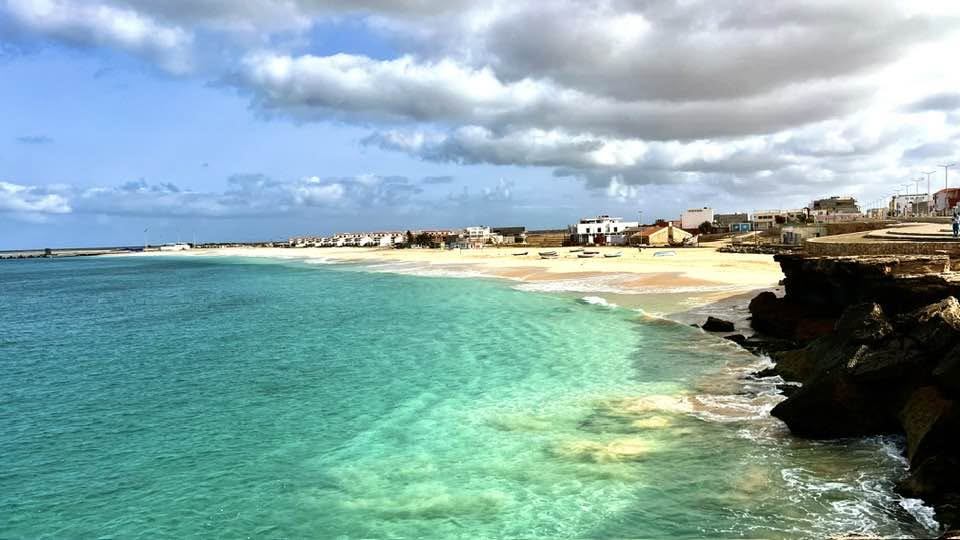
The island's real asset: miles of practically untouched sandy beaches with no resort development - with clear differences in swimming safety.
Praia da Vila
The town beach right by Vila do Maio, and therefore the easiest to reach - yet still nearly empty most of the time, with calm, gently sloping water.
Praia do Morro & Praia de Santana
Long, untouched stretches of coastline - visually striking, but with sometimes strong undercurrents and explicitly not recommended for swimming. Praia do Morro also doubles as a lookout point for passing humpback whales in April/May.
Praia de Baxona (Calheta)
Practically wave-free all year - together with the flat, calm beaches of Cadjetinha and Praia Real, one of the island's safest places to swim.
Praia de Ponta Preta
Between May and September, shifting sand regularly forms a natural swimming hole here roughly 20 m deep - from October, the sand recedes and the pool disappears again until the next season.
Praia Real
Flat, calm, and at the same time a documented refuge and nursery area for nurse sharks - a protected bay where young lemon sharks also grow up. Watch from a respectful distance.
Praia Gonçalo & Praia Ribeira Dom João
Praia Gonçalo lies roughly 18 km northeast of Vila do Maio near Pedro Vaz - completely unspoiled, reachable only by rental car or quad bike. Praia Ribeira Dom João is simultaneously a turtle nesting ground and sits within the tourist development zone of the new special economic zone.
Not Every Beach Is Suitable for Swimming
Unlike the main tourist islands, Maio has no uniform flag system or lifeguards. Praia do Morro, Praia de Santana and Praia de Santo António are explicitly considered unsuitable for swimming due to strong currents - Praia de Baxona, Cadjetinha and Praia Real are the more reliable alternatives.
That's the total size of the Maio UNESCO Biosphere Reserve (ca. 26,900 ha land, ca. 47,072 ha sea) - it covers the entire island along with its coastal waters, and was recognized on 28 October 2020, together with Fogo, as one of Cape Verde's first two biosphere reserves.
Maio Is Also a Conservation Story.
Seven protected areas, one Ramsar wetland, and a salt-trading history over 400 years old - Maio is more than empty beaches.
Parque Natural do Norte da Ilha do Maio
At roughly 25,601 ha (ca. 4,714 ha land, ca. 20,887 ha sea), by far the island's largest protected area and one of the largest protected areas in the whole country. The park includes the "Terras Salgadas" in the northwest - once its own, separate reserve, now administratively folded into the park - home to the most extensive salt ecosystem in the entire archipelago: dunes, lagoons and salt marshes that serve as habitat for flamingos, spoonbills and numerous migratory birds.
Salinas do Porto Inglês
These historic salt-production works shaped the island's economy for centuries - at roughly 5 km long and 1.5 km wide, Cape Verde's largest natural salt flat, split into "salina grande" and "salina pequena." Recognized as a Ramsar wetland of international importance since 3 July 2013 (Ramsar No. 2182, roughly 535 ha) - the country's fourth Ramsar site. A cooperative still operates the salt works today, supported by independent collectors.
Cape Verde's Third-Largest Nesting Colony
Maio ranks among the five largest loggerhead turtle nesting colonies in the world, and is the country's third largest after Boa Vista and Sal. Scientific surveys confirm a clear preference among the turtles for nest sites on the island's east coast. Watching has required a license since October 2024, and is only allowed between 7pm and midnight with a nature guide.
Ilhéu de Laje Branca
An offshore islet, roughly 70 m wide, 350 m off the island's north coast, part of the Parque Natural do Norte. It's home to the only white-faced storm petrel colony ("pedreiro azul") on Maio itself - archipelago-wide, further colonies exist on Ilhéu Branco, Ilhéu dos Pássaros and the Ilhéus do Rombo. The species nests in ground burrows and is legally listed as a rare species.
Not Just Nurse Sharks: Lemon and Tiger Sharks Documented Too
For Maio's marine ecosystem, UNESCO explicitly documents, alongside the common nurse shark, the lemon shark (Negaprion brevirostris) and the tiger shark (Galeocerdo cuvier). A protected bay near Praia Real demonstrably serves as a refuge for nurse sharks and a nursery area for young lemon sharks - one of the few documented shark nurseries in the entire archipelago. Also documented are eight locally endemic snail species (including Conus boavistensis) and three endemic lizard species, among them Tarentola mayensis.
Small Island, Few Towns.
Maio has only a handful of settlements - which makes getting your bearings refreshingly simple.
Vila do Maio (Porto Inglês)
The island's only town of any size - administrative seat, ferry port and tourist base all in one, home to most of the island's few guesthouses and restaurants. The harbor, modernized in 2019-2022 for roughly €20 million (345 m long, 3-10 m deep), remains vulnerable despite the upgrade: the Ro-Ro ramp repeatedly fails due to sand buildup or heavy swell - most recently in June 2026, due to strong waves - at which point only passenger traffic runs, no vehicles or cargo.
Calheta
A small settlement in the island's interior, shaped by simple farming. Nearby lies Cape Verde's largest contiguous forest area - a historically planted acacia reforestation zone.
Barreiro
The island's most photogenic village - every facade painted a different color, a striking contrast to the otherwise barren landscape. Alongside the beaches, the most obvious day trip from Vila do Maio.
Ribeira Dom João & Pau Seco
Since Law 11/X/2022, part of the Zona Económica Especial da Ilha do Maio (ZEEIM) - with special tax rules (customs and tax relief) inside the free zone. This is also where the controversial "Little África Maio" megaproject is planned: 342 ha in area, with the first construction phase meanwhile reduced from €500 million to roughly €200 million - as of January 2026, construction still hasn't started and depends on approval by the Council of Ministers.
What to Experience on Maio.
Turtle Watching (Jun-Oct)
Officially licensed since October 2024: operators pay 15,000 CVE (renewal 10,000 CVE), visitors pay a conservation fee of 2,200 CVE (foreign visitors, age 16+) or 1,650 CVE for younger visitors. Watching only between 7pm and midnight, exclusively with a nature guide - flash photography, bright flashlights and phone light are strictly forbidden.
Humpback Whale Watching (Feb-May)
Alongside Boa Vista, Maio is one of the important breeding grounds for humpback whales in the eastern North Atlantic, peaking in April/May. Watching is subject to a legally mandated minimum distance - best booked with a licensed, experienced operator. From Praia do Morro, you can sometimes spot the animals breaching from land.
Exploring by Rental Car or Quad
The best way to reach the island's scattered beaches and villages - there's no fixed bus line or dense Aluguer network here like on the larger islands. Inside the protected areas: stick to designated routes only, zones under integral protection are completely off-limits.
Fishing & Boat Trips
Informally organized trips with local fishermen from Porto Inglês - fishing is, according to UNESCO, the most important direct economic benefit from the marine zone. No fixed ticketing system, best to ask directly on the ground.
Salt Flats Visitor Center & Photography
The Centro Interpretativo at the Salinas do Porto Inglês explains the island's salt history. The untouched stretches of coastline and salt marshes also make for good photo subjects - part of a habitat that, across the whole biosphere reserve, hosts over 100 registered migratory bird species.
Simply Doing Nothing
The real main attraction for many Maio travelers: beach days with no schedule, no entertainment, no vendors - for some, that's the real luxury.
Fundação Maio Biodiversidade Under Funding Pressure
The 2025 report from Fundação Maio Biodiversidade (FMB) shows impressively what's being achieved here: over 13,000 nests, 87 documented poaching cases, 34 dead and 55 rescued animals, around 100 staff, a budget of over 9,000 contos. At the same time, FMB reports noticeably growing challenges in funding its work for the 2025/26 season - one more reason to use licensed tours and official channels rather than informal offers.
That's how many loggerhead turtle nests Fundação Maio Biodiversidade counted in the 2025 season alone - making Maio one of the five largest nesting colonies of this species worldwide, and the country's third largest after Boa Vista and Sal.
How Much Time to Plan for Maio?
Two example rhythms for orientation - not a rigid plan, but a template to adapt.
Quiet Short Trip
- Day 1: Arrival by CVsky domestic flight or ferry, arrive in Vila do Maio
- Day 2: Salinas do Porto Inglês, Centro Interpretativo & excursion to nearby Barreiro
- Day 3: Rental-car trip north to the Parque Natural do Norte or to Praia Gonçalo
- Day 4: Rest day at the beach (Baxona or Praia Real), return journey
Nature & Digital Detox
- Day 1-2: Arrival, Vila do Maio, first beach days
- Day 3-4: Parque Natural do Norte, Terras Salgadas, Calheta
- Day 5: Boat trip or fishing tour from Porto Inglês
- Day 6-7: If traveling Feb-May: humpback whale watching; Jun-Oct: licensed turtle tour; otherwise unplanned beach days, return journey
Combine With Fogo & Brava
- Day 1-6: as above - explore Maio at a relaxed pace
- Day 7-10: domestic flight or ferry on to Santiago, then to the volcanic island of Fogo, optionally a ferry crossing to Brava - three very different Sotavento islands in one trip
How Do You Get to Maio?
No direct flight from outside Cape Verde - every route runs via another Cape Verdean island.
Via Praia or Sal
⚠ Subject to changeAfter your international arrival, CVsky (Linhas Aéreas de Cabo Verde, ATR 72-600 fleet) continues on to Maio Airport (MMO) - the flight time from Praia alone is roughly 20 minutes (a direct distance of just 37 km), with about 4 connections a week. CVsky took over Cape Verde's domestic flights from TACV (Cabo Verde Airlines) in late March/early April 2026 - older sources that still say "Cabo Verde Airlines" are outdated.
Ferry From Praia
CV Interilhas connects Praia and Vila do Maio with the ship "Praia d'Aguada," scheduled three times a week (Sundays plus Wednesdays/Fridays) in just under 2 hours. The Ro-Ro ramp at the port of Porto Inglês repeatedly fails due to sand buildup or swell - at which point only passenger traffic runs, no vehicles. Firmly planning a rental car around the ferry crossing is therefore risky, and ferry schedules change on short notice - never travel by ferry on the day of your international return flight.
Arriving & Getting Around.
What actually matters after landing - cash, SIM card and getting around the island.
Entry & Registration
Travelers from the EU, UK, US and Canada can enter visa-free for stays up to 30 days; most other nationalities, including Australia, get a visa on arrival. Either way, the online registration via the official EASE portal (ease.gov.cv), including airport tax (currently around 3,400 CVE / €31), is mandatory - at the latest 5 days before departure, exclusively through the official site. Numerous third-party sites charge a noticeable markup for the same process - officially, it's only around €31 directly via ease.gov.cv.
A Rental Car Is Nearly Essential
Unlike the larger islands, there's no dense Aluguer network here - if you want to see more than Vila do Maio and the nearest beach, a rental car is hard to avoid. The local vehicle selection is limited, so booking ahead is worthwhile - especially since vehicle transport by ferry isn't reliable given the Ro-Ro ramp failures.
Money & ATMs
ATMs on Maio are scarce and found almost only in Vila do Maio - plan to bring enough cash before you arrive, since card payment is practically impossible outside the main town.
SIM Card & Network Coverage
Alou and Unitel T+ both have coverage on Maio too; network coverage is reliable in Vila do Maio, patchier away from it. Don't expect continuous reachability on more remote beach days.
Power & Water
Drinking water comes entirely from seawater desalination. Power supply long ran exclusively off a single diesel plant - since 2026, the government has been investing more heavily in solar power, aiming for a noticeably higher renewable share. Occasional power outages still happen, so a power bank is worth packing.
Tipping & Etiquette
There's no fixed tipping system. In the island's few restaurants, rounding up voluntarily is common but not expected.
Rules of Conduct in the Protected Areas
◐ Community valueSince nearly a third of the island is under protection, clear rules apply: no driving off designated routes, whether on beaches or dunes. Zones under integral protection are completely off-limits. In the rainy season (August/September), driving off the main road is additionally dangerous - plan for landslide and washout risk. Fresh fruit and vegetables sometimes can't be carried between islands while island-hopping, to avoid spreading pests.
What You Should Watch Out For.
General Safety
Maio is considered one of the quietest and safest islands in Cape Verde. Ordinary caution is enough: don't leave valuables unattended, don't swim far out alone at unsupervised beaches with currents. Check your own country's current travel advisories before departure.
Medical Care
Only one Centro de Saúde (health center) in Vila do Maio for basic care, no hospital. Pharmacies likewise exist only in the main town - bring any specialist medication yourself, in sufficient quantity. For more serious emergencies, evacuation runs by domestic flight or helicopter to Praia (Hospital Dr. Agostinho Neto) - international health insurance with genuine repatriation cover is not an extra on Maio, but mandatory in practice.
Health & Vaccinations
The usual travel vaccinations (including tetanus/diphtheria, hepatitis A) are recommended - consult a doctor before your trip. Cape Verde has been officially malaria-free since January 2024. In 2023/2024 there was a nationwide dengue outbreak (around 19,000 cases, 8 deaths, declared over in January 2025) - initially centered on Fogo, but shifting clearly to the capital Praia on Santiago as the year went on - treat this as general, nationwide Cape Verde information rather than a Maio-specific risk.
Emergency Numbers
Police 132 · Fire Brigade 131 · Ambulance 130. According to several international travel sources, these are also reachable without a SIM card (we couldn't find an official confirmation that calls are free of charge) - save them to your phone right on arrival.
Where to Stay?
Deliberately without invented individual prices: prices change constantly by season and provider. These categories help you get oriented - check current prices via the booking links below.
Budget
Guesthouses in Vila do Maio- Simple, family-run rooms
- Often with half-board - local cuisine
- The bulk of the island's accommodation
Mid-range
Small hotels & vacation homes- A small but growing selection
- Some near the beach, outside Vila do Maio
- Booking ahead in high season is worthwhile
Premium
Barely exists - for now- No classic resort segment like Sal or Boa Vista
- The "Little África Maio" megaproject (342 ha, ZEEIM special zone) could change that in the medium term - but as of early 2026, construction start remains open
- Until then: the island's honest, uncommercial character
Check current prices and availability for all categories directly with each provider.
What Does a Week on Maio Cost?
€ Price guideBallpark figures per person and week on the ground (excluding flights), highly dependent on season and style - for rough orientation, not an exact quote.
| Category | Budget | Mid-range | Comfortable |
|---|---|---|---|
| Accommodation | Simple guesthouse | Small hotel / vacation home | A handful of upscale options |
| Food | Local cuisine, half-board | Mix of restaurants & self-catering | The island's best available restaurants |
| Local transport | On foot in Vila do Maio | Occasional rental car | Rental car throughout |
| Activities | Beach, free exploring | Boat trip or licensed turtle tour | Multi-day rental-car exploring + tours |
Planning More Than Just a Vacation?
A quiet retreat, conservation, or real estate interest in the new special economic zone - three topics that go beyond simple vacation planning.
Digital Detox & Quiet Retreat
Barely any nightlife, barely any distraction, but plenty of time for yourself - Maio works better as a deliberate retreat than as a day-to-day change of pace.
Best Time & Climate →Biosphere Reserve & Species Protection
UNESCO Biosphere Reserve, Cape Verde's third-largest turtle nesting colony, documented shark and whale populations - relevant for travelers with a strong interest in conservation.
Cape Verde Fauna & Flora →Real Estate & the Special Economic Zone
Since 2022, parts of Maio fall under the ZEEIM with tax advantages for property purchases. The planned "Little África Maio" megaproject could change the market in the medium term - have the progress and credibility of any individual offer independently checked before making any payment.
Available soon (EN)What Actually Helps on Maio.
Not a generic travel packing list, but what makes a real difference specifically on Maio.
- Enough cash in escudos - ATMs are scarce on the island
- Sun protection with a high SPF, ideally reef-safe
- Tropical-grade insect repellent (DEET or icaridin)
- A power bank - occasional power outages happen on Maio
- A time buffer for domestic flight or ferry connections - the Ro-Ro ramp and weather are unreliable
- Your national driving licence, plus an International Driving Permit if renting a car
- Offline maps or GPS - signage outside Vila do Maio is sparse
- A reusable water bottle and your own snacks for remote beach days
- Your EASE confirmation and return ticket, both digital and printed, ready to hand
- If planning a turtle tour (Jun-Oct): book a licensed guide in advance, bring no flash photography gear
Sources & Page Status
- "Quietest island" superlative softened: in four places the text stated "the quietest island" as a flat factual claim, while another spot already correctly said "considered one of the quietest" - there's no objective noise-level ranking of the islands, so the wording has been standardized to the editorial "considered" framing throughout.
- Emergency number fee-free status clarified: as with other pages on this site, we couldn't find an explicit official confirmation that calls to 132/131/130 are free of charge, so we added the independently confirmed fact that the numbers are reachable even without a SIM card instead.
- Airline: since late March/April 2026, CVsky (no longer TACV/Cabo Verde Airlines); flight time Praia-Maio roughly 20 minutes (corrected from a previous, incorrect "under 10 min").
- Terras Salgadas is part of the Parque Natural do Norte da Ilha do Maio (PNNM, ca. 25,601 ha), no longer a separate reserve.
- Praia-Maio ferry: CV Interilhas, ship "Praia d'Aguada" confirmed (not "Kriola," which primarily serves the southern line).
- Nesting colony: third largest in Cape Verde, after Boa Vista and Sal (not Santiago).
- Population: 6,330 (2021 Census, INE Cabo Verde).
How Our Members See It.
Questions About Maio.
Are there direct flights to Maio?
No. Maio is only reached via domestic flights from Praia or Sal (since late March/early April 2026 with the new airline CVsky), or alternatively by ferry from Praia. International arrival is first into Sal or Santiago.
Is Maio suitable for a first Cape Verde visit?
Not really as a sole destination - for a first visit with good comfort, Sal or Boa Vista are a better fit. Maio is worthwhile once you already have a sense of Cape Verde and are specifically seeking quiet and nature.
Do you need a rental car on Maio?
In practice, yes - unlike the larger islands, there's barely any dense public transport network. If you want to see more than Vila do Maio, a rental car is hard to avoid.
Can you watch turtles on Maio?
Yes, between June and October. Watching has required a license since October 2024: only between 7pm and midnight, exclusively with a nature guide, for a conservation fee of 2,200 CVE for foreign visitors.
How many days should you plan for Maio?
3-4 days is enough for a first impression; for a genuine quiet week, plan for more like 7 days - many travelers come deliberately without a tight schedule.
Why is Maio a UNESCO Biosphere Reserve?
The entire island, including its coastal waters, was recognized on 28 October 2020, together with Fogo, as one of Cape Verde's first two UNESCO Biosphere Reserves - due to its seven protected areas, species-rich marine ecosystems, and importance as a turtle nesting ground.
What additional fees apply on Maio?
Besides the airport tax, the statutory Taxa de Turismo applies on the ground: 276 CVE (ca. €2.50) per person and night from age 16, capped at a maximum of 10 nights. Turtle tours add a conservation fee on top.
Are there sharks and whales on Maio?
Yes - UNESCO documents nurse, lemon and tiger sharks in Maio's waters, as well as seasonal humpback whales (peaking February to May). Whale watching has been regulated since 2024 (minimum distance of 80 m).
Why is the airline now called CVsky instead of Cabo Verde Airlines?
CVsky (Linhas Aéreas de Cabo Verde) took over Cape Verde's domestic flights from TACV in late March/early April 2026. Older sources citing "Cabo Verde Airlines" for domestic flights are outdated accordingly.
How long does my passport need to be valid for Cape Verde?
At least 6 months valid from the date of entry into Cape Verde - not from the date of departure.
How to Plan Maio - Step by Step.
Three steps from idea to booked trip - adapted for an island that needs a bit more preparation than the main tourist islands.
Sort Out Getting There & Buffer Time
Check the current CVsky flight schedule and CV Interilhas ferry times - and build in a time buffer from the start in case the Ro-Ro ramp or weather gets in the way.
To the Getting-There Overview →Compare Flight, Ferry & Accommodation
Current prices for Maio all in one place - the bar at the bottom of the screen stays visible as you scroll, so you can compare anytime.
Get the Insider Knowledge
Emergency numbers, community experiences, and the 360° Check for an honest read on whether one of Cape Verde's quietest islands is really right for you.
Start the 360° Check →Ready for Maio?
Compare current prices for flights, hotels and rental cars, or take a look at the other 8 islands first before deciding.