


Cachupa, Grogue & the cuisine of two continents.
Corn and beans from Africa, olive oil and sausage from Portugal, fish and seafood from the Atlantic: centuries-old trade routes converge on the plate in Cape Verdean cuisine. Cachupa, the slow-cooked corn-and-bean stew, is considered the national dish, Grogue sugarcane spirit the national drink - and on Fogo's volcanic soil, wine and coffee even grow that have gone on to win international awards.
Cape Verdean cuisine at a glance.
- National dish
- Cachupa (corn, beans, meat or fish), Rica & Pobre variants
- National drink
- Grogue, sugarcane spirit at approx. 40% ABV, 80% of production on Santo Antão
- Ponche (Pontche)
- Grogue sweetened with sugarcane honey, Slow Food Ark product
- Coffee
- Fogo Arabica grown on volcanic soil, over 200 years of cultivation tradition, Slow Food Ark product
- Wine
- Volcanic wine from Chã das Caldeiras (Fogo), 1,500-1,700 m elevation, multiple award winner
- Cheese
- Bolona goat cheese (Santo Antão), Slow Food Presidium, 2017 Slow Cheese Award
- Seafood
- Lagosta (spiny lobster), Búzio (sea snail), Caldo de Peixe (fish soup)
- Corn dishes
- Xerém (corn porridge), Cuscuz cabo-verdiano, Djagacida (Fogo)
Cachupa - history, slowly cooked.
Cachupa is a slow-cooked stew of corn (hominy), beans, vegetables, and meat or fish - the Cape Verdean national dish, full stop. Its ingredients tell the archipelago's colonial history: corn and beans came from West Africa, olive oil and sausage from Portugal, fresh fish and seafood from the surrounding Atlantic. The result is the product of centuries of blending between West African, Portuguese, and South American influences.
There are two main variants: Cachupa Rica ("rich Cachupa") is prepared with various types of meat and sometimes tuna, while the simpler Cachupa Pobre ("poor Cachupa") consists mainly of corn, beans, cabbage, and a bit of oil - traditionally with pork fat instead of expensive meat, to keep costs low. Preparation is a genuine ritual: corn and beans are soaked the day before, then simmered for hours.
Leftover Cachupa is never thrown away: as Cachupa Refogada (also called Cachupa Guisada), it's drained the next morning, pan-fried, and served with a fried egg, often alongside Linguiça sausage or fried mackerel, as a classic breakfast.
Grogue & Ponche - sharp and sweetened.
Cape Verde's national drink comes from sugarcane - and to this day is still largely produced the traditional way.
Grogue
A sugarcane spirit whose first documented distillation dates back to 1504 - roughly a century after Portuguese settlement began, after sugarcane was first cultivated on the archipelago around 1490. About 80% of total production comes from Santo Antão, where the cane grows in fertile valleys, is pressed on traditional mills ("Trapiche"), and distilled in small distilleries - artisanal Grogue reaches alcohol content between 38 and 60%, with standard product at around 40%.
Ponche (Pontche)
Grogue sweetened with sugarcane honey (sometimes also refined with lime and cinnamon) to soften the sharpness of the pure spirit. Ponche is considered a classic welcome drink, served in practically every household for every occasion, and is listed as a worth-preserving culinary heritage item in the Slow Food Ark of Taste.
Wine & coffee on volcanic soil.
In the caldera of Chã das Caldeiras on Fogo, vines and coffee plants grow among black lava - one of the most unusual growing regions in the Atlantic.
Volcanic wine from Chã das Caldeiras
At 1,500 to 1,700 meters elevation, right inside the caldera of Pico do Fogo, vines grow among lapilli, black ash, and dry-stone walls. Red, white, and rosé wines are produced, as well as an amber Passito made from white muscat grapes dried on the volcanic rocks. After the 2014/2015 eruption destroyed the original winery, it was rebuilt - wines like "Chã Branco," "Chã Tinto," and "Chã Passito" have since won gold medals at the Mondial des Vins Extrêmes.
Fogo coffee
Arabica coffee (Bourbon and Typica) has been grown on Fogo for over 200 years - according to several independent coffee trade and cultural sources (not an agricultural certification body), fully organic, without pesticides or chemical fertilizer, irrigated exclusively with rainwater. The mineral-rich volcanic soil gives the beans an aroma with notes of chocolate, caramel, tropical fruit, and red berries with balanced acidity. Due to the arid climate and declining yields, Fogo coffee is considered an endangered cultural asset and is listed in the Slow Food Ark of Taste.
Fish, corn & cheese.
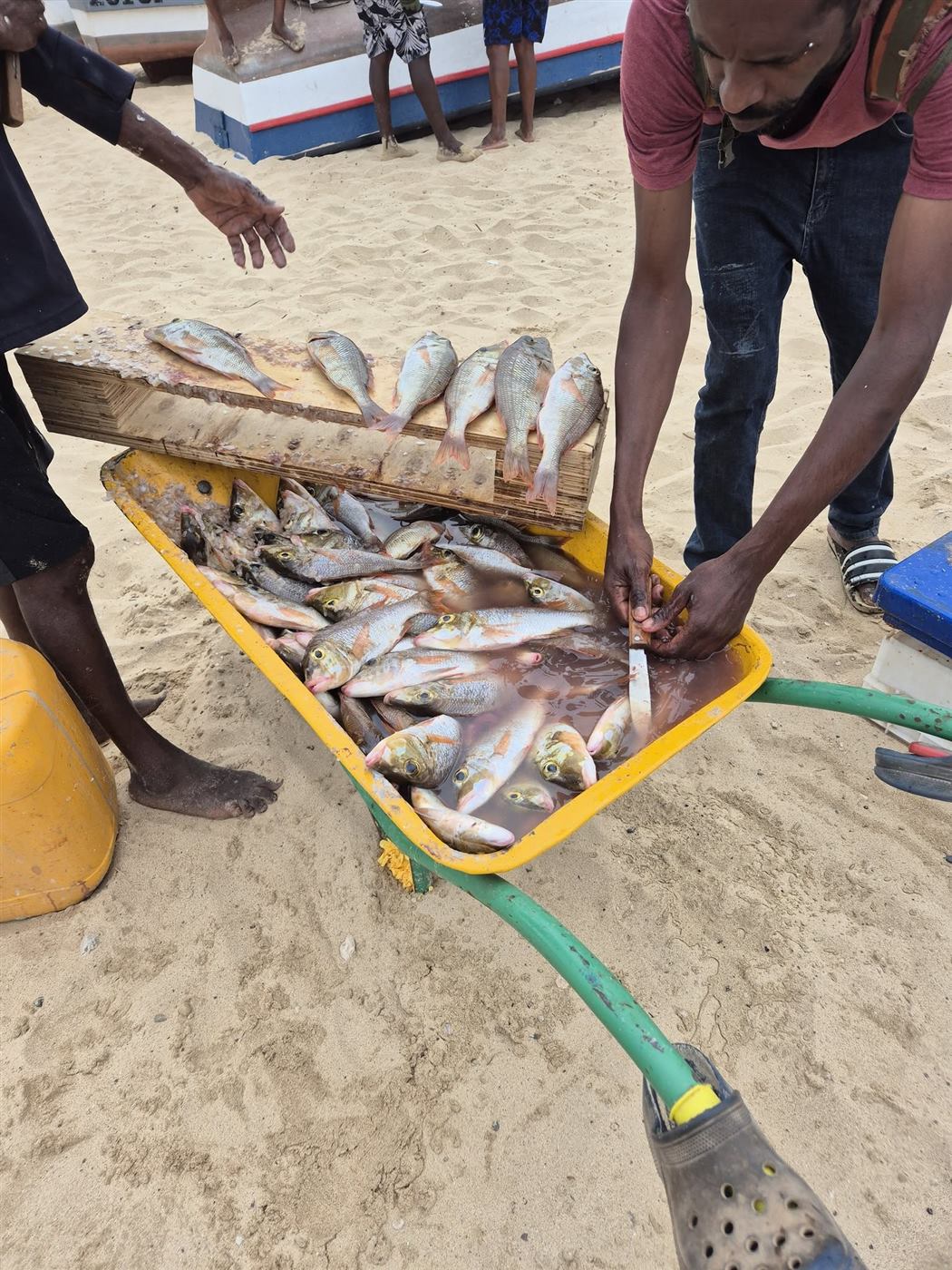
Besides Cachupa, fish and corn dishes above all shape the Cape Verdean menu. Caldo de Peixe is a lightly seasoned fish soup with potatoes, carrots, cassava, and pumpkin, usually served with rice or corn porridge. Búzio is a seafood stew made from a large sea snail in a tomato-coconut milk sauce. Popular on Sal is Lagostada: spiny lobster, cooked over hot coals, seasoned with garlic butter and served alongside Xerém and sweet potato. Pastel com o diabo dentro ("pastry with the devil inside") is a fried pastry pocket with a spicy chili filling that gives the dish its name.
Among corn dishes, Xerém dominates - a coarsely ground corn porridge, often cooked with salted pork or fish, garlic, and onions. Cuscuz cabo-verdiano - despite its name, not to be confused with North African couscous - is a corn cake steamed in a clay vessel ("Binde"), usually eaten warm with butter or sugarcane syrup. Typical on Fogo is Djagacida: cornmeal, beans, cabbage, salted meat or fish, and the small, spicy Favona bean.
Among cheeses, Bolona goat cheese from Santo Antão stands out: it's made in Bolona, a small village on a semi-arid plateau, from raw goat milk with no added water, no heating, and no refrigeration - a herd of around 7,000 goats secures income for more than 60 families there. The cheese was the first Cape Verdean product to be recognized at an international Slow Food event in 2007, and won a Slow Cheese Award in Italy in 2017.
Three Cape Verdean products in the Slow Food Ark of Taste
Fogo coffee, Ponche, and the Cape Verdean goat (as the basis of Bolona cheese) are listed on the international "Ark of Taste" run by the Slow Food Foundation - a catalog of endangered, culturally significant food traditions considered worth preserving. A good compass for travelers: trying these three products gives you an authentic cross-section of Cape Verdean food culture.
Sources & status of this page
- Cachupa (Rica/Pobre, preparation, Cachupa Refogada): generally recognized Cape Verdean everyday knowledge, consistently described across multiple independent culinary-culture sources - no single source needed.
- Grogue (80% of production on Santo Antão, 38-60% ABV, corrected 10/27/2026): consistent with scholarly literature (Economic Anthropology) and the Slow Food Ark of Taste listing. The previously cited year "around 1462" incorrectly referred to the founding of the first Portuguese settlement - sugarcane cultivation itself is documented only from around 1490, and the first documented distillation (then still called "aguardente de cana sacarina," not "Grogue") dates from 1504. Main text and FAQ have been corrected to 1504 accordingly.
- Fogo wine (Chã Branco/Tinto/Passito, gold medals at the Mondial des Vins Extrêmes): confirmed directly via research - the winery won gold or "Grand Gold" medals across multiple vintages (incl. 2024, 2025) at this competition for wine from extreme terroirs.
- Fogo coffee & Ponche as Slow Food Ark products (refined 10/15/2026): the Ark of Taste listing itself, as well as growing elevation and harvest time (Feb./March), are confirmed directly via the official Slow Food Foundation page. The Slow Food page itself does NOT address organic/pesticide-free status or the exact varieties - these details (fully organic, no pesticides, rainwater irrigation only, Bourbon & Typica) come consistently from several independent coffee-trade/cultural sources (incl. meetcaboverde.com, cabo-verde.cv, Barista Magazine), not from an agricultural certification body - flagged as a secondary source.
- Bolona goat cheese (7,000 goats, over 60 families, Slow Food recognition 2007, Slow Cheese Award 2017): the goat-herd and family figures come from a Slow Food press release; the official Slow Food Presidium page itself independently cites "22 herders/cheesemakers" as active Presidium members - both figures likely refer to different reference scopes (whole region vs. Presidium cooperative) and are presented here without conflating them.
Questions about Cape Verdean cuisine.
What is Cachupa?
Cape Verde's national dish - a slow-cooked stew of corn, beans, vegetables, and meat or fish, blending West African, Portuguese, and Atlantic influences.
What's the difference between Cachupa Rica and Pobre?
Cachupa Rica is prepared with various types of meat (sometimes tuna), while the simpler Cachupa Pobre consists mainly of corn, beans, and cabbage with a bit of oil or pork fat - cheaper, but the more common everyday variant.
What is Grogue?
A sugarcane spirit at around 40% alcohol content (artisanal versions up to 60%), whose first documented distillation dates back to 1504. About 80% of production comes from Santo Antão.
Is there wine in Cape Verde?
Yes - in the Chã das Caldeiras caldera on Fogo, at 1,500 to 1,700 meters elevation, red, white, rosé, and Passito wines are grown on volcanic soil, which have already won gold medals internationally.
Which fish dishes are typical?
Caldo de Peixe (fish soup), Búzio (sea snail stew), and the Lagostada (grilled spiny lobster) popular on Sal are among the best-known fish and seafood dishes.
What is Ponche (Pontche)?
Grogue sweetened with sugarcane honey - the classic Cape Verdean welcome drink, listed as a worth-preserving culinary heritage item in the Slow Food Ark of Taste.
More about Culture & People.
Want to learn more about Cape Verde?
Discover the history, nature, and daily life of the archipelago - or plan your trip directly with our 360° Check.